

China Digital Times

Torch Relay Ends with a Bang (Updated with video)

BBC is reporting that four foreigners have been arrested in Beijing for scaling 120-foot light poles and unfurling 140 square foot pro-Tibet banners outside the Bird’s Nest stadium during the final leg of the Olympic torch relay:

Meanwhile state media reported that four pro-Tibet activists from Britain and the US had been arrested in Beijing after a brief protest close to the Olympic stadium.

They had unfurled two large “Free Tibet” banners from electricity poles, despite tight security.

Students for a Free Tibet is taking credit for the stunt.
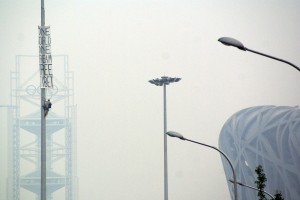
Free Tibet banner

Read also: Tibet protesters fly flag near Beijing’s Bird Nest on the Star by Bill Schiller.

The Xinhua reports, via the China Daily: 4 foreign nationals ordered to leave China:

Two Americans and two British nationals have been ordered to leave China “within a prescribed time limit” after displaying “Free Tibet” banners near an Olympic venue in Beijing on Wednesday, local police said.

Two are expected to leave on Wednesday night and the other two on Thursday.

“They disrupted public order and violated Chinese laws. Their period of stay in the country will hereby be cut short according to the Law of the People’s Republic of China on Control of the Entry and Exit of Aliens,” the Beijing Municipal Public Security Bureau said in a statement issued late on Wednesday.

The four, three men and one woman, had entered China on tourist visas.

They gathered at about 5:47 am at the Beichen Overpass near the National Stadium, or Bird’s Nest, in Chaoyang District in northeast Beijing.

Two of the men climbed up two electricity poles and hung the banners.

One banner bore large black letters declaring “One World One Dream Free Tibet,” while the other said: “Tibet will be free” in English and “Free Tibet” in Chinese.

Local police rushed to the scene 12 minutes later and took them away.

The Guardian reports: Tibet demo Britons ‘to be deported‘:

Two British Free Tibet campaigners are in custody in China after unfurling a Tibetan flag and banner outside the Olympic stadium.

Lucy Fairbrother, 23, and Iain Thom, 24, were arrested in Beijing alongside two US activists. All four are expected to be deported at the earliest opportunity, according to Chinese news agency Xinhua.

As the British Embassy in the Chinese capital continued to try to get access to the pair, who are members of Students for a Free Tibet (SFT), their families spoke of their pride.

This news on the web, via Google News.
POSTED COMMENTS: 135 Responses

  • Fellow Chinese, get ready with our baseball bats & make sure we get to these bastards white shits first & give them real bloody noses (literally speaking) before our police arrive!

  • @TrulyAsia:
    If you are allowed to voice your opinion freely in this forum, you should allow the same freedom to others. In fact, inciting others to beat up people is a lot more questionable than peacefully unfurling a banner…
    In most internet forums, even the People’s Daily, a comment like yours would deservedly get blocked or removed.

  • B-R-A-V-O for such great courage and determination to speak up for something that you four truly beleive in.

    I salute you all for fighting for JUSTICE!

    Best Wishes,
    Racheal

  • Bravo for being stupid. Why would you write something in English? If you would going protest on China write it in Chinese so all the Chinese could see it.

  • [...] Torch Relay Ends with a Bang [...]

  • lol [whatever your name is]

    First and foremost, it would be much convincing to us if you can elaborate of their [banner hangers] encouragement to stand up for Tibet as “stupid.” With no such explanation or sense of understanding, it makes yourself sound stupid.

    Second, it is understood that Beijing, being capital of China, has enough educated people who knows how to read English. Plus, Beijing is covered with tourists who are there for the Olympics and for many other purposes, which you refer as “stupid.”

    Best Wishes,
    Racheal

  • Gotta love Racheal’s false sincerity (”Best Wishes”). It’s commonly used by “activist” and “human rights” groups. We Chinese have a phrase for it: “xiao li chang dao.” If you don’t know what it means, read up on your Chinese history and culture before you speak up about Chinese issues.

    Do you realize Tibetans had no running water or electricity and a 3% literacy rate before the Communists came? Do you realize they were oppressed as feudal peasants?

    Did you know that the literacy rate is now 97% and Tibetans drive BMWs and Mercedes like the rest of the capitalist world?

    Read a UN report before you go running your mouth about issues that only upper-class trust-fund babies are ignorant enough to rant about.

  • First, I want all Chinese to know that there are millions of huaqiao throughout the world who support Beijing’s right to host the 2008 Olympics. Ni men shi wo men de xiong di jie mei, wo men yong yuan hui zhan zai ni de shen bian.

    China took over Tibet in 1949. The US took land from the Native Americans throughout the 19th century.

    In the same way that I don’t think the US needs to return half of the continental United States to the Native Americans, China doesn’t need to return a portion of its land to its previous owners.

    By Chinese-American | August 6th, 2008 at 1:28 pm
  • I hate getting into these arguments because they turn bitter and, frankly, rather silly quickly, with both sides–myself included, often–overstating themselves.

    However, I still don’t completely understand three arguments that are often used by critics of anyone concerned about the situation of Tibetans.

    First of all, these critics often highlight the U.S. genocide of Native Americans. Obviously, this was a monumental crime. While it is understandable that few are willing to return land—in the U.S. or China–it seems strange to be satisfied with a state of affairs that is brutal in either case.

    If you are serious in your criticisms of the Native American genocide, there is a lot you can do to help, and I mean this in complete seriousness. The American Indian Movement, which has fought for Native American rights for decades can be reached here: http://www.aimovement.org/

    Are you serious? Are you committed to fighting injustice everywhere and angry that the plight of Native Americans has been overlooked? Or are you just bringing up another country’s tragedy to justify a similar tragedy in China—in other words, do you just believe that if something bad happens twice it is no longer bad in either case?

    Second, why is Tibet’s pre-”liberation” situation always highlighted in isolation? What I mean is, EVERYWHERE, including traditionally Han-dominated parts of China, was poorer before 1949 than it is now. Rather than emphasizing again and again that Tibet is no longer the exact same place it was fifty years ago, why not ask how Tibet has fared compared to its Himalayan counterparts (Bhutan, Nepal, Northern India) or, if you prefer, compared to the rest of China. I don’t mean that the answer will be simple, but it is certainly a more reasonable comparison.

    Third, why is a very traditional, top-down model of development always said to be best for Tibet? All I ever hear talk of from you critics are big railroads, the joy of local elites (the BMWs and Mercedes mentioned by “azn”), the prevalence of local superstitions (which is rhetoric reminiscent of British colonialism), and how China is pouring such and such amount of money into such and such—not the more holistic ideas of development pushed by the Left or by opponents / reformers of financial institutions or, for that matter, increasingly by financial institutions themselves? Why is there no attention to the gap between rich and poor within Tibet and the job opportunities for non-Mandarin speakers?

    It sometimes seems as if the critics of Tibet sympathizers are intent on pushing a very right-wing vision of the world. That vision scares me wherever I see it—in China or anywhere else.

    Am I wrong?

  • @Chinese-American:
    At least you are admitting that China “took over Tibet in 1949″. And it is not exactly a convincing argument that China has the right to repeat the same injustices that have happened in previous centuries…

    That doesn’t mean that China does not have the right to host the Olympic games. Not at all.
    Simply, these eggs don’t belong in one basket…

  • @jh:

    Now you white bums start to reveal your true colour~intolerant of anti West comments? So, your preachings of freedom-this-&-that are really nonsence, huh?

    Yeah, incitement of voilence/racial hatred for no obvious reasons is disgraceful, I am totally agreeable to this; but to do so in defence of the honour of one’s nation/family/loved ones is certainly not, mate! Just get the shit out of our backs/country, for God’s sake!

  • @Truly Asia:
    I suggest you are mixing up things…
    Where was my comment “intolerant of anti West comment”? Do you care to waste a thought on what you read before lashing out yourself?
    Any amount of critical comment is welcome if it has sense and decency.

  • AZN,

    I pity you for thinking that it is my false sincerity when I end with “best wishes.” I have been commenting for the last few years with that phase. If you don’t like, you can minus that because it only applies to those who are intellectually understandable and want to learn more from sharing each other’s views and sources. It seems that you are not that person and your mentality of how huge impact China has made in Tibet is preventing you from being a constructive commenter and learner. Anyhow, I pity you for such arrogance.

    The world knows that China had made alot of changes that materially affected the lives of Tibetans. We, citizens of the world, are not in-denial. However, China is destroying things that Tibetans treasure. Granted that literacy has increased dramatically, but what percent of Tibetans [especially younger generation Tibetans in Tibet] are not taught Tibetan language [even in TAR]and what percent of Tibetan parents don’t send their children to school because they can’t afford the fees or don’t want their children to forget Tibetan language and culture.

    I am not “running” my “mouth about issues that only upper-class trust-fund babies are ignorant enough to rant about.” I am making my point from many different source from both sides of the issue and basing the argument based on those sources. I think you are in great need of such research and analysis.

    If you want to talk about China’s so called “economic liberalization” for Tibet, please read Andrew Fisher’s report on this topic. He went to Tibet and China for this research and I find it very helpful and convincing.

    Best Wishes,
    Racheal

  • Also,

    I have read most the UN reports on this matter and as far as I understand, they are pretty clear in emphasizing that such developments does materially impact Tibetans’s lives, but only those who live in big cities. The reports are clear that majority of Tibetans live in rural areas because they are mostly farmers and nomads.

    Considering you read those UN documents, I assume you read those thousands of Human Rights Violations Report that Chinese government is held accountable for. When you carefully analyze those so called “developments” with those human rights violations that the world recognizes as it is proved, then, try to convince us what is really your point, instead of chanting your mantra of how great China is and instead of “rant”[ing] about my words of wisdom of “best wishes.”

    Best Wishes,
    Racheal

  • “they are pretty clear in emphasizing that such developments does materially impact Tibetans’s lives, but only those who live in big cities. The reports are clear that majority of Tibetans live in rural areas because they are mostly farmers and nomads.”

    The same holds true in China today. There is a huge socioeconomic disparity between urban and rural residents. There is discrimination against rural peoples as well. But this is the same everywhere. This is a fact of life. Remember the fairy tale of “The Country Mouse Goes to the City”? Europe, the US, Africa, South America, Asia — everywhere you will find instances of where the cities are much better off than the countryside.

    The question is to what extent the nation can lift its people out of poverty. You see to like the UN, so I’ll use their example. They found that China was the most effective of ANY country in the world at reducing poverty rates within its borders. That’s more than the USA, Europe, all those wonderful liberal democracies. Why? Because sometimes authoritarianism is needed in a country that amounts to 1.5 billion people with issues such as regionalism, factionalism, and political turmoil in play. THAT’S an achievement if I ever saw one.

    Blaming the pinko-commie Chinese is the easiest path. I thought we as liberals are beyond that?

  • To Old Tales Retold:

    1) Remember when Pelosi said “we have lost all moral authority to speak on behalf of human rights anywhere in the world.”?

    I highlight the US genocide of Native Americans to make the point that Americans did not have much moral authority to begin with.

    2) Tibet has fared similarly to the rest of China; that is to say, the cities have prospered at the expense of the countryside. But this is simply a prerequisite of successful capitalist development. It’s quite the same in Europe and the United States.

    3) Yes! Someone else who has read Said’s Orientalism! I completely agree with you that it is likely a load of BS to talk about how China has “modernized” Tibet through the same rhetoric as imperialist Britain. However, the majority of people in the Western world today think along those lines. Thus I am merely streamlining and framing my argument in terms that will appeal and make sense to the greatest audience.

    OTR I think we really do see the issue from similar angles, we simply arrive at different conclusions. To each his own.

  • To azn,

    1) I understand now why you highlight the Native American genocide, but I respectfully think you still miss the point. If we look at the issues of Native Americans or Tibetans (or Kashmiris, West Papuans or Kurds for that matter) apart from the whole context of “China said and the U.S. said and then China said and the U.S. said…” and just deal with them as moral issues and practical issues, not as talking points for various nation-states, can’t we agree that the situation is pretty bad in all cases and needs to be remedied?

    2) It’s true that China as a whole suffers many of the same problems that Tibet does in a microcosm. But Tibet experiences them to greater extremes—just as it experienced many of the mass campaigns of an earlier period to a greater extreme (except land reform initially).

    Besides, I’m not a big fan of “capitalist development” myself, so I’m not sure that that argument will work great with me! Argue things using Amartya Sen or someone on the Left and I’ll be a little more receptive.

    3) It is indeed comforting to know someone else here is analyzing things from the same framework, with Edward Said et al hanging around the backs of our heads! And I appreciate that we can do so and still arrive at different conclusions—it would be a rather dull, restrictive framework otherwise.

  • @OTR

    I am yet to be convinced that Tibetans experienced suffering to greater extremes now or in the past. But I am open to be convinced.

    The current Chinese government seems to believe that the problems of Tibet are just like problems of other poor inland provinces, they are nothing that rapid development can’t cure. The strategy is to make adjustments to gradually tilt the balance of government investment from urban to rural, from coast to inland, from those people that were allowed to get rich first to those that were left behind.

    However, I think that situation for Tibetan is very unique within the Chinese context. A poor Han farmer in Gansu province can not look to a savior to suddenly lift him out of his condition, so he look at the first multi-story brick house in the village for inspiration and a path out. A poor Tibetan farmer in the next village has more options: he can try to send his sons to a monastery, maybe their lives will be better; or he can look to the inspiration of Dalai Lama, maybe he is the savior; or he can choose NOT to overlook the multi-story brick house in his village or in the Han village, and decide send his sons to learn Chinese.

    Chinese government also has several options concerning Tibetans. It can simply invite Dalai Lama back as a spiritual leader of Tibetan Buddhism, maybe that poor Tibetan farmer will live in spiritually fulfilled poverty. It can wait for Dalai Lama to die and continue their current policy, that Tibetan farmer will finally make a choice for his sons between the monasteries and the schools. Or Chinese government and Dalai Lama can finally decide to put ideology and sovereignty questions aside, instead using the government investment and international donations to build schools where Tibetan, Chinese and probably English are taught together with math, science, maybe even a bit of Tibetan Buddhism. Then the Tibetan farmer will have no choice but to send his sons to school and leave the decision of whether to enter monastery until they are 18.

  • Wu Ming makes a number of very good points. I would like to point out that the most important issue here is basic survival. If you ask any ordinary Chinese citizen in nearly any city, they will tell you that finding employment for themselves or their children is the number one priority and challenge. The fact is the educational system in China today is churning out increasing numbers of college graduates that the economy simply cannot sustain. The economy would have to sustain yearly GDP growth of 10-15% in order to accommodate employment opportunities for all of the new graduates each year.

    Wu Ming points out that Tibetans have more options than Han Chinese. While this may seem unbelievable to kneejerk liberals/conservatives, the fact is that ethnic minorities in China receive special benefits ranging from special cafeteria beef dishes for Hui (Chinese Muslims who don’t eat pork) and affirmative action in the form of increased college admission indexes. These same benefits apply to Tibetans.

    I think the most important lesson to draw from Wu Ming’s post is that the majority of Chinese people are in a phase of “fen dou”, or struggle to survive. How can you ask over a billion people struggling to find employment to put food on the table to support the independence of a region that accounts for 1/5 of the nation’s land mass? Such a move would undercut China’s growing need for natural resources as it struggles to become a “developed” country like the US and Europe.

    By agitating for Tibetan independence, extreme left-wingers are in effect championing the right-wing agenda of “buffering” or “containing” China through obstacles that prevent China from attaining sufficient economic development and autonomy. China needs the resources in Tibet for the development that will allow the majority of its people to RISE OUT OF POVERTY.

    The Chinese people today have the five-star red flag as their primary source of pride. Feudalism and the ways of the imperial past have been discredited both by the capitalist nations of the West and the political ideology at home. China as a nation is poorer than the West, the Chinese people have lower per-capita income than their Western counterparts, Chinese watch Hollywood movies and listen to English music while taking on English names - when the Chinese people hold their nation as one of their few yet strong sources of pride, how can you ask them to so freely release it?

  • @azn, OTR, wuming:
    That has been a worthwhile exchange of thoughts…
    I, for my part, have been interested in the “Tibet issue” for 20 years, and I find that I am still learning…
    What I would like to point out is the following:
    - The Dalai Lama or the exile government DO NOT demand independence! Therefore the issue should not be unduefully “hyped up”.
    - It is about the cultural and religious autonomy of Tibetans. And, I think, every Han who has been to Tibet or knows Tibetans will agree that Tibetans DO THINK differently from Han.
    - If the Chinese government keeps its current repressive policies in Tibet in place, the Tibetans will only get more resentful - towards the government as well as the Han.
    Once the Dalai Lama passes away, the Tibetan youth may not be prepared to “put up with autonomy only”.
    And one day even China will be democratic, and then the Tibetans may opt to quit China as so many former states of the USSR have done.
    And then it will have been the Han themselves who have destroyed the unity of their China…

  • Sorry, I was being too cute in my previous post. I probably did not make my point clear.

    In my opinion, one of the key problems for Tibetans is that the disaffected Tibetans are looking for a savior in the person of Dalai Lama to deliver them from their current state. Too many of them counted on a Dalai Lama led independent Tibet to solve all their problems. When an equally disaffected Han or Hui Chinese will count only on themselves. The Tibetan expectation is unrealistic in two ways: first, Chinese government of any political leaning will not let Dalai Lama and TGIE govern Tibet; second, HHDL will not be able to solve most of the poor Tibetans’ problem even if he were to govern Tibet. When high expectations are not met, they fracture the society. If you take a look at the failed states around the world, the expectation gaps are often at the root of the failures.

    Therefore I think Dalai Lama is more of a problem than a solution, not because he intends harm on Tibetans or even Chinese, but because his high profile around the world for an unrealistic cause helps to widen the expectation gap. Even from his latest olive branch so breathlessly published by Kristof of New York Times, he still need to come down several more pegs before a realistic solution can be found.

  • There is no question “that the Tibetan expectation is unrealistic”…
    The Dalai Lama has stated repeatedly that he will hold no political role once a satisfying resolution of the Tibet issue has been achieved. Also, the TGiE has no claims on ruling Tibet once an acceptable degree of autonomy is in place. And varying levels of autonomy are in place in many countries of the world - even in China itself if you look at Hongkong.

    While it may be generally true that an expection gap may be at the root of failures, in particular, as suggested, in so called “failed states”, it can hardly be applied to Tibet which existed as a functioning nation state - with fluctuating borders and degrees of independence - since the 7th century or earlier.

    Furthermore, it is being suggested that the Dalai Lama is more of a problem than a solution because “disaffected Tibetans are looking to him as a saviour”.
    This may seem so for an outsider (and Han Chinese are outsiders as far as Tibetan culture, religion, customs, language etc. are concerned) but it misses the core of the Tibetan identity. Tibetans are deeply religious and proud of their leader who enjoys unparalleled worldwide respect - with one exception which is the PRC government (the Taiwanese government, in contrast, has no issue with the Dalai Lama).
    And the reason is that the Communist government of the PRC has a political problem of their own making in Tibet and cannot therefore admit the truth.
    The truth being that the aspirations of the Tibetan people are best met by Tibetans themselves, not by some Communist Han cadres from Beijing who don’t share anything with the people whose lives they decide upon.

    As the Chinese were not supposed to put up with colonial rule by Japanese or Western powers, so the Tibetans cannot be expected to put up with outside imposed rule either.

    That being said, it does not mean that Tibetans, Han, Uighurs and others cannot live together in one country.
    But at the moment China is multi-ethnic only as far as folklore as concerned. It has a long way to go to meet the aspirations of ALL its people - not only those of the Han.

  • How the hell 6 million tibetan decide the fate of 1.3 billion Chinese Not in your dream

    It will never happened not in your lifetime as long as 1 Chinese still left in this world

    You can whine all you want but Teritorial integrity is deeply etched in Chinese DNA whether it is KMT or Communist

  • @George:
    Who said that the Tibetans want to decide the fate of 1.3 billion Chinese? I don’t know what you are talking…
    Do you know what you are talking?

  • George,

    What are you talking about?

    Best Wishes,
    Racheal

  • Point to be noted to all:

    in 2004, the Chinese government issued White Paper on the Regional Ethnic Autonomy in Tibet that Tibetans are entitled to the following rights: full political right of autonomy; full decision-making power in economic and social development undertakings; freedom to inherit and develop their traditional culture and to practice their religious belief; and freedom to administer, protect and be the first to use their natural resources, and to independently develop their educational and cultural undertakings.

    Best Wishes,
    Racheal

  • Hi all,

    “We cannot rewrite history but together we can determine the future.”

    - His Holiness the Dalai Lama

    Best Wishes,
    Racheal

  • “The frog at the bottom of the well thinks too small. He thinks the sky is only as big as the top of the well. If he surfaced, he would have an entirely different view.”

    -Mao Ze Dong

    To Tibetan independence supporters:

    We must look at this situation from a different angle: political practicality. If Tibet were to become an independent state, who would rule it? The Tibetan Youth Congress? The religious elite? The Dalai Llama? Students for a Free Tibet?

    If you can answer this question then I will consider your argument to have at least partial merit.

  • @ Wuming and Azn,

    Before this discussion got caught up in the whole debate about independence versus autonomy versus rule by Beijing, etc., you brought up some very good points–about Tibetans’ reliance on HHDL as a “savior” and what this means for activism, about the different choices facing ordinary Han and Tibetans, and about various ways forward. Wuming’s thoughts on expectations are particularly insightful.

    I would like to go back a little further in the discussion, though, and give a try at addressing Wuming’s questions about Tibetan suffering, from my limited knowledge.

    I understand that, as in many countries, the ethnic majority in China feels that minorities benefit immensely from affirmative action policies. This perception, true or not, is always a powerful force in domestic policy anywhere. See, for example, European popular attitudes toward the benefits given recent immigrants or U.S. attitudes toward university policies that seek to boost minority admissions.

    I don’t mean that China is exactly like these other places just because it also has affirmative action policies. I mean that in all cases, perceptions aside, the question remains: do these policies make up for other structural or cultural forces keeping minorities down?

    There have been a few good articles of late that lay out the unique difficulties facing Tibetans in a fairly even-handed way.

    Tsering Shakya had a piece in the New Left Review last spring with which you, Wuming and Azn, might find yourselves often in agreement, but which also goes into Tibetans economic and cultural dilemmas (he ultimately emphasizes the cultural side):

    http://www.newleftreview.org/?view=2720

    And, of course, there are those articles by Andrew Fisher (or is it Fischer?) that are worth quoting. The most concise and worthwhile one is, I think, the one in Far Eastern Economic Review. I can’t for the life of me track down an active link to the article—it seems to have been moved—so here are some quotes (excuse me for writing too long of a post):

    “The first and most fundamental [mistake] has been Beijing’s fast track strategy to “develop” Tibet through the force of massive amounts of subsidies and subsidized investments, the newly constructed railway being one such example. These strategies have resulted in rapidly rising inequalities, to a level much higher than that observed anywhere else in China, where rising inequality is already a source of great concern.

    The second oft-noted trend is a corollary of the first; the in-migration of non-Tibetans (most Han Chinese) from elsewhere in China. The railway has increased the number of these migrants, although this is primarily due to subsidies, not the existence of the railway infrastructure itself.

    The third trend has been the abandonment of most previously-existing mechanisms to protect local labor in the context of such out-of-province migrant inflows. This trend is particularly important because it affects the upward aspirations of many relatively well educated urban Tibetan youths. For instance, the government recently ended its policy of guaranteeing employment for local high school and university graduates. As elsewhere in China, the old system has been replaced with competitive exams for the coveted posts of state-sector employment, although the exams, as elsewhere in China, are in the Chinese language. As a result, even relatively well educated Tibetans are easily out-competed by Han Chinese migrants, even Han Chinese migrants from Chinese rural area.

    The fourth trend has been the tightening of political control by the government in response to rising tensions.”

    In terms of the intensity of problems in Tibet versus Han China in the not-so-distant Maoist past, I think the most powerful example is the Great Leap Forward. The famine hit Tibet (and Anhui and a couple other places) disproportionately hard. In fact, the Panchen Lama risked his remaining power to call it tantamount to genocide (he was only rehabilitated in the 1980s).

    Jasper Becker has some good numbers on death rates in Tibet during the GLF I often find Becker a tad over-dramatic and less-than-complete in his take on things, but on the figures I think he’s on fairly firm ground. I can check the books when I get home if you want specifics.

    Later, the Cultural Revolution was carried out with particular violence in Tibet—so much feudal and superstitious stuff destroy—and, moreover, left extremist cadres (Tibetan and Han) in power for longer than in other places.

    Many policies were late in coming to —but hit harder.

    Ultimately, though, I think what JH has been saying has the greatest weight. It is one thing to suffer and it is another thing to suffer at what you see to be someone else’s hands. Does this distinction make a lot of practical difference? Maybe not. But it is wrenching culturally.

    I am reminded of Israelis who have told me that Palestinians enjoy better conditions than their counterparts in many Arab countries (I don’t know if they would still say this after the economic blockade of Gaza). That argument always struck me as a little beside the point.

  • “It is one thing to suffer and it is another thing to suffer at what you see to be someone else’s hands. Does this distinction make a lot of practical difference? Maybe not.”

    In fact, it makes all the difference! Tibetans can look to the South Himalayan Tibetan regions in India and Bhutan which are all intact. Does anyone think that the Tibetans would have inflicted the ongoing wholesale destruction of their culture on themselves?
    Moreover, the whole Tibetan cultural hemisphere from Kalmykya and Mongolia to Ladakh and Bhutan is being robbed of its heartland! The Tibetans have built their own civilization over 2000 years - only to watch it being marginalized and destroyed by the Han…

  • @ Jh,

    My next sentence after that was, “But it is wrenching culturally.” I think that more or less matches your sentiment.

    Reading over my comments, though, I realize they were, way, way too long—-a little more editing needed!

  • Hey all,

    I found this on Tibetan Government in Exile India, formally known as Central Tibetan Administration [CTA] on future Tibet.

    The following is the official translation of The Guidelines For Future Tibet’s Polity And Basic Features of Its Constitution, which His Holiness issued on 26 February 1992. In this, His Holiness makes important suggestions for future Tibet’s democracy. He categorically declares that he will not hold official position in the government of future Tibet since he thinks that he will be “in a better position to serve the people as an individual outside the government”.

    Introduction

    Although it is difficult to predict the future, all human beings who wish to achieve happiness and avoid suffering must plan for future. As a result of the Chinese occupation, Tibetans in Tibet are deprived of their basic human rights; this tragic situation cannot be permitted to continue for long.

    Tibet has a recorded history of over 2,000 years, and according to archaeological findings, a civilization dating back to over 4,000 years. In terms of geographical features of the country, as well as in terms of race, culture, language, dress and customs, Tibet is a distinct nation.

    Under Tibet’s Kings and the Dalai Lamas, we had a political system that was firmly rooted in our spiritual values. As a result, peace and happiness prevailed in Tibet.

    However, by the middle of this century, Chinese occupation forces marched into Tibet through its eastern border regions of Kham and Amdo. Soon after, the Chinese intensified their military repression in Tibet, driving our political situation to a crisis point. In the face of this, I had no alternative, but to comply to my people’s request to assume full responsibility as the head of state of Tibet, although I was then only 16.

    In the hope of winning peace and happiness for my people, I tried for years to establish an amicable relationship with the powerful and authoritarian Chinese officials. Also, I set out to reform the unsavory aspects of our social system. With the view to introducing democracy, I constituted a committee consisting some 50 members. On the recommendation of the committee, some social welfare reforms were implemented, but my efforts towards introducing further reforms failed as the Chinese had by then converted Tibet into their colony.

    As soon as the Chinese army had gained full control of Tibet, they shed their initial semblance of discipline and politeness to become ever more demanding and repressive. Brutal forces were used to suppress the Tibetan resistance, first in Kham and Amdo, and finally in the whole of Tibet by March 1959.

    As a result, I was compelled to seek refuge in India in order to continue our struggle for the cause of Tibet. Among my initiatives in exile were to see to it that the Tibetan refugees, who were arriving in India in thousands, were given proper education and rehabilitation facilities. I also set out to continue my earlier plans to democratise Tibetan society.

    People’s Deputies (the Tibetan legislative body), was introduced in India. Since then we have had eleven such Assemblies. In 1961, I promulgated a constitution for future, free Tibet, based on the principles of modern democracy. In general, this Constitution received overwhelming support from the Tibetans. The Tibetans, however, strongly opposed one provision, which stipulated that if circumstances demanded, the power of the Dalai Lama could be taken away according to the Constitution. Therefore, this provision had to be revised.

    In 1963, an even more comprehensive draft constitution was announced. In an attempt to democratise the exile Tibetan Administration, the Assembly of Tibetan People’s Deputies was entrusted with the authority to abolish the traditional bipolar system of appointing monk and lay officials to each position. The Assembly also annulled all the hereditary titles and prerogatives granted to small groups of people under the old system. In its place, new guidelines were introduced by which government officials would be appointed in a democratic fashion.

    The 1963 draft constitution also authorised a Council of Regents to assume the powers of the Dalai Lama under specific circumstances if that was seen to be in the highest interest of the nation. In deference to the wishes of the people, as I stated earlier, and circumstances prevailing at that time, the constitution gave the ultimate authority of the government to the Dalai Lama. Naturally, I was not satisfied with this clause. I felt that this constitution fell far short of my aim for a genuine democracy.

    Therefore, in my speech of the March 10 Anniversary in 1969, I declared that when the Tibetans regained their right to rule themselves, the people must decide for themselves as to what kind of system of government they wanted. I also stated that it was not certain whether the system of government with the Dalai Lama as the supreme head would continue or not.

    About three decades have passed since the draft constitution of 1963 was promulgated. During those years, the world has changed dramatically and people throughout the world have begun to value democratic rights more than ever before. They have realised that democracy is the foundation for the free expression of human thoughts and potentials. Therefore, Tibet also must change when it becomes free.

    With regard to the question of Tibet, although it is an international issue, the Chinese leadership has failed to respond positively to my overtures of 1987 and 1988. This is unfortunate, because I undertook these two initiatives as sincere and timely efforts to find a peaceful solution to the issue of Tibet.

    The issue of Tibet is not merely a question of the survival of a people with their own distinct history and culture, it also has direct bearing on the fate of this world and Asian peace, and particularly upon the relationship between the world’s two most populous nations: India and China. At stake is also the serious question of human rights, as enshrined in the United Nations Universal Declaration of Human Rights, and the world body’s efforts to put an end to the era of colonialism and expansionism. Even the Chinese people themselves are opposed to the present Chinese system of governance and are demanding changes.

    Chinese dissidents in exile have come to realise and accept the reality that Tibet and China are two completely separate entities. They have also come to recognise the fact that the Tibetans have the right to independence and self-determination. They find no justification in their leadership’s claim that Tibet is a part of China.

    Globally speaking, the values of democracy, freedom and justice are being appreciated and accepted more widely, especially in Eastern European countries where the totalitarian system, labelled centralised democracy, is giving way to a true and free democracy. The peoples of these nations are now gaining freedom and independence from oppressive regimes.

    Similarly, the Tibetan Administration and population in exile, and more especially the Tibetans in Tibet, are striving hard for our freedom. For over 40 years, our brethren in Tibet have lived under an oppressive and tyrannical regime, completely deprived of basic human rights. Naturally, 99 percent of them - be they young, old, cadres, officials - are deeply resentful of the Chinese occupation of Tibet.

    Despite the tremendous risks involved, many young people in Tibet have chosen to sacrifice their personal interests to demonstrate against Chinese rule in Tibet. Today there is much better understanding of the Tibetan issue in the world and this has heightened international interest in, and support for, our cause. In the light of this, the Chinese leadership will have no alternative but to abandon its rigid policy and come to the negotiating table to find a peaceful solution to the question of Tibet. It will not be long before the Chinese rulers find themselves compelled to leave Tibet.

    When this joyful occasion comes, the time when the Tibetans in Tibet and those in exile are re-united in a free Tibet, the present totalitarian system, dubbed centralised democracy, will have to give way to true democracy under which the people of all the three provinces of Tibet, namely U-Tsang, Kham and Amdo, can enjoy the freedom of thought, expression, and movement. My hope is that Tibet will then be a zone of peace, with environmental protection as its official policy. I also hope that Tibetan democracy will derive its inspiration from the Buddhist principles of compassion, justice and equality.

    I believe that in future, Tibet should have a multi-party system of parliament, and that it should have three organs of government - legislature, executive and judiciary - with a clear separation of powers between them, each independent of the other and vested with equal powers and authority. As I have often said, Tibet belongs to Tibetans, and especially to those who are in Tibet.

    Therefore, Tibetans in Tibet shall bear the main responsibility in future Tibet’s democratic government. Moreover, Tibetan officials presently serving the government of Chinese-occupied Tibet should bear even greater responsibility as they have more experience in running the affairs of the state. It is important that such Tibetan officials eschew all feelings of uncertainty and doubt. Instead, they should strengthen their determination to improve the quality of the future administration of Tibet, and re-dedicate themselves to the cause of Tibetan freedom.

    Of course, some Tibetans, egged on by their Chinese masters, have said and done detrimental things. They have done this either due to ignorance or out of fear. Therefore, I see that no purpose will be served by seeking retribution for their past deeds. What is vitally important is to strive unitedly for a happy future.

    Personally, I have made up my mind that I will not play any role in the future government of Tibet, let alone seek the Dalai Lama’s traditional political position in the government. There are important reasons why I have made this decision. There is no doubt that Tibetans, both in and outside Tibet, have great hope in, and reverence for, me. From my side too, I am determined to do whatever I can for the well-being of my people. The fact that I am in a position to do this is due to my karma and prayers over past lives. However, in future I will not hold any official position in the government. I will most likely remain a public figure who may be called on to offer advice or resolve some particularly significant and difficult problems which could not be overcome by the existing government or political mechanisms. I think I will be in a better position to serve the people as an individual outside the government.

    Moreover, if Tibet is to survive as an equal member of the modern international community, it should reflect the collective potential of all its citizens, and not rely on one individual. In other words, people must be actively involved in charting their own political and social destiny.

    It is, therefore, in the interests of the Tibetan people, both long- and short-term, that I have come to this decision, and not because I am losing interest in my responsibilities. There is no need to worry on this count.

    Once Tibet regains its freedom and the Chinese forces are withdrawn, there will be a transitional period before the adoption of a new constitution. During this period the existing Administration in Tibet, with all its Tibetan functionaries, will be retained to look after such affairs of State, such as health, economy, education, culture, and transport and communications. This means the Tibetan officials presently working under the Chinese should be ready to assume full responsibilities.

    The interim government will be headed by a president, who will assume all the political powers presently held by me. The present Tibetan Government-in-Exile will be considered dissolved ipso facto. Although no one will be entitled to special privileges by virtue of his/her position in the Tibetan Administration in exile, I hope the officials of the exile Administration will willingly accept whatever responsibilities are entrusted to them in view of their qualifications, experience and abilities.

    The principal responsibility of the transitional government will be to form a Constituent Assembly with representatives from all parts of Tibet. The Constituent Assembly, in turn, will prepare Tibet’s new constitution on the basis of various drafts prepared in exile. This new constitution will be adopted only with the assent of the interim President. Then, in accordance with the constitution, the interim President will appoint an Election Commission, which will conduct the election of the new government.

    ——————————————————————————–

    Provisional order during the transitional period

    The time between the withdrawal of repressive Chinese forces from Tibet and the formation of a new Tibetan government, elected in accordance with the democratic constitution, shall be referred to as the “transitional period”.

    Since we must have an interim President to head the government during the transitional period, the following procedures will be followed to appoint him or her.
    I shall constitute a small committee of leaders from Cholka-Sum, or the three provinces of Tibet. This committee, in consultation with the officials of various departments throughout Tibet, will summon an emergency meeting of all the deputies representing administrative divisions no smaller than a district.The meeting, in turn, will elect not more than seven candidates, from whom I shall appoint one as the President.
    In the event of this meeting failing to elect the candidates, I shall directly appoint the interim President.

    The interim President, whether appointed directly or from the elected candidates, will take the oath of office in my presence.

    Upon taking the oath of office, the interim President will be vested with all the powers and responsibilities of government hitherto entrusted to me.

    The interim President will form a Constituent Assembly. Within one year of its formation, the Constituent Assembly will finalise the new Constitution of Tibet, after studying the draft proposals.

    The interim President will appoint the Chairperson and other members of the Election Commission. In accordance with the newly-adopted constitution, the Election Commission will conduct the election of members of the Tibetan legislative bodies, their chairpersons, as well as the President and the Prime Minister.

    The entire process - from the date of adoption of the Constitution to the election of legislative members and the President and the formation of the government - should not exceed two years.

    The Constituent Assembly of Tibet shall comprise of not less than 250 representatives elected from cities, towns, regions, districts, etc.

    The first task of the Constituent Assembly will be to establish the rules on the basis of which it will conduct its proceedings.

    The Constituent Assembly will be deemed to have ceased to exist as soon as the new parliament is sworn in.

    Likewise, the interim President, and the Election Commission appointed by him will relinquish their positions as soon as the new Assembly is sworn in. From then on, the business of a representative form of government will begin in accordance with the Constitution.
    The preparation of comprehensive draft constitutions for several alternative models of democracy is underway at the moment. However, the Constituent Assembly, comprising of representatives from all regions of Tibet, will have a final say in deciding which form of constitution should be adopted. What I have done here is to give a preliminary picture of what to expect in future Tibet’s democratic set-up.

    ——————————————————————————–

    Principal Features of the Constitution

    Salient Features:
    The Constitution of Tibet will be the supreme law and source of all political powers in Tibet.

    Nature of Polity:
    The Tibetan polity should be founded on spiritual values and must uphold the interests of Tibet, its neighbouring countries and the world at large. Based on the principles of Ahimsa, and aimed at making Tibet a zone of peace, it should uphold the ideals of freedom, social welfare, democracy, cooperation and environmental protection.

    Fundamental Principles of the Government:
    The Tibetan Government will observe and adhere to the United Nations Universal Declaration of Human Rights, and promote the moral and material welfare of its citizens.

    Renunciation of Violence and Military Force:
    Tibet will be a zone of peace, based on the principles of nonviolence, compassion and protection of the natural environment. Tibet will remain nonaligned in the international communities and will not resort to war for any reason.

    Fundamental Rights:
    All Tibetan citizens will be equal before the law. They are entitled to equal rights without discrimination on grounds of sex, race, language, religion, social origin, etc.

    Other Fundamental Rights:
    All Tibetan citizens will have the right to life, liberty and property; and freedom of speech and expression, freedom to form associations, to publish and disseminate news and views. They will have the right to be gainfully employed, whether in the government or in any institution or department under its authority.

    Right to Vote and Hold Public Office:
    All citizens of Tibet, men or women, will have the right to hold public ofce and vote in accordance with the law.

    Ownership of Land:
    For the benet of the people and their habitat, the lands within the territory of Tibet shall be distributed appropriately according to the nature of the land. The distribution of lands will be for the purpose of residence, farming, buildings, factories, business and other livelihood purposes. Lands not privately owned will remain with the state.

    The Economic System:
    Avoiding the two extremes of capitalism and socialism, Tibet will formulate a special economic system to suit its own needs. The taxation system of Tibet will be based on income criteria.

    Education and Culture:
    Since education is key to the development of good human beings and to ensuring social progress, special attention will be paid to formulate a sound educational policy. All assistance will be given to schools, universities, institutes for science, technology and other professional trainings.

    Public Health:
    A public health care system will be established in order to provide adequate health care facilities to the people.

    Legislative Power:
    The legislative power of the Tibetan Government will be vested in the two chambers, namely the House of Regions and the House of People. Bills passed by them must receive Presidents assent before becoming law. The House of People will be the highest law-making body. It will consist of representatives directly elected by citizens from all constituencies, which will be demarcated in accordance with population distribution. The House of Regions will consist of members elected by the assemblies at regional level. A limited number of members (the number to be specied in the Constitution) in this House will be nominated by the President.

    Executive Power:

    If the parliamentary system of government is adopted, there shall be a President and a Vice President elected by members of the two national-level Houses and regional assemblies.
    The executive power of the government, under the parliamentary system, will rest with the Prime Minister and the Council of Ministers formed by the Prime Minister. The Prime Minister must be from a party or any other group constituting majority of members present in the House of People. Failing this, all the members of the House of People will elect the Prime Minister.
    Judicial Power:
    For the purpose of interpreting and upholding the Constitution, as well as for ensuring impartial adjudication of cases involving the State or individuals, there will be a judicial organ which is independent of the other two organs, legislative and executive, of the government. There will be a Supreme Court, which is the highest judicial and appellate court of justice.

    Regions:
    The Tibetan National Assembly will decide the demarcation of Tibets regions after taking into account the regional economic, geographical, demographic, and transport and communications features. In each region, there should be an assembly consisting of members elected by the people of the particular region. This assembly will be the regional legislative organ.

    Also, every region will have a Governor appointed by the President, and a Cabinet headed by a chief Regional Minister, who in turn, is elected by the regional assembly. All the judicial power in the region will be vested in a regional High Court.

    In view of the local needs, the regional assemblies can pass laws and regulations affecting their respective regions. Except for some very important matters, the regional assemblies will have the full authority to make decisions governing their respective areas of jurisdiction.

    This is an example of one model of parliamentary system. There are various other models of parliamentary or non-parliamentary democracies. A draft constitution based on each of these models is being prepared in consultation with legal experts so that the future Constituent Assembly can choose the one that is seen to be most suitable to Tibet. It is not for me to make this decision.

    ——————————————————————————–

    Conclusion

    Known as the Roof of the World, Tibet is in the heartland of Asia between India and China. The people of Tibet are by nature honest, gentle and kind.

    Future Tibet will be a peace-loving nation, adhering to the principle of Ahimsa. It will have a democratic system of government committed to preserving a clean, healthy and beautiful environment. Tibet will be a completely demilitarised nation.

    Although technological advancement has brought material prosperity to much of today’s world, it has also resulted in the loss of respect for human beings. Human beings have also lost much of their freedom, so much so that they have become the slaves of machines. While a privileged few live in an island of plenty, the vast majority have to go without even the most basic necessities of life.

    In order to prevent this kind of economic disparity, a more preferable economic course needs to be charted for future, free Tibet. Although we will go for a free economy, our economic policy will be aimed at serving the interest of the nation and general masses. We will make efforts to ensure that all the citizens are able to get the basic necessities of life.

    In our international policy, Tibet will not align itself with the policy and ideology of any other nation. It will remain neutral in the true sense of the word. Tibet will maintain harmonious relations with its neighbours, based on equality and mutual benefit. It will renounce hostility and promote friendly relations with all nations.

    I hope all sincere and right-thinking Tibetans will strive with a sense of pride and joy to attain the goals I have stated in the foregoing lines.

    Best Wishes,
    Racheal

  • http://www.tibet.net/en/ohhdl/future.html

  • It is independent in all but name So the figleaf finally got revealed. Don’t talk anynmore about “Yes but Tibetan are willing to compromise and want to stay within China ”

    I say keep on dreaming

  • @Rachael, George:
    I don’t know whether it is really worthwhile digging out and arguing about a document dating back to 1992. The Dalai Lama’s envoys are currently working out a detailed autonomy plan for the next meeting in October. My understanding is that it is based on the Chinese constitution which allows for meaningful autonomy.
    What objections should anyone have against a constitutional proposal?

    That the current Communist government does not follow its own constitution is a different matter of course…

  • Constitutional proposal eh. with Tibet having their own parliament. And incorporating 3 Chinese province that they NEVER exercise souvereignity .I just wonder if these people halucinating or what. This people LOST the war again and again but they have the gall to DEMAND concession from the winner.Who they think they are

  • “His Holiness makes important suggestions for future Tibet’s democracy.”

    Except according to “His Holiness” himself, the Dalai Llama now only wants autonomy and not independence:
    http://www.dalailama.com/news.42.htm

    Rachael, perhaps you should fast-forward to 2008. And stop copy&pasting the thoughts and arguments of one man as a substitute for your own.

  • @ George,

    It is not so unusual for negotiations over autonomy to continue well past the initial subjugation of a people.

    Of course, it is entirely reasonable to disagree with the specific demands made by the Tibetans or the Chinese, as you and I do—I just wish these arguments were not just carried on between us nobodies, but between Dharamsala and Beijing in real, high-level talks. None of this United Front silliness.

  • “Except according to “His Holiness” himself, the Dalai Llama now only wants autonomy and not independence:”

    But he demand a separate parliament, Chinese army out of Tibet, No Han immigration to Tibet, Return to the old Theocracy. Considering his age and waning control over his more radical follower

    One wonder how long it is before Tibetan declared De Facto independece and ask for international intervention?

  • Hey all,

    My intention is not to create such rift in the discussion. I just threw the information out there to re-emphasize that issue of Tibet is not just about His Holiness the Dalai Lama, but its about 6 million Tibetans. This was made clear since this document was release till today by His Holiness. His Holiness clearly said that Tibetan people will decide the future of Tibet.

    Best Wishes,
    Racheal

  • I can see George’s point. If Tibet had its own parliament, and if its people voted for independence, China would indeed have a problem. I think it is this fear of the current Chinese government that is in the way of any progress.
    I saw a picture with a banner recently which I found amusing. It said:
    “Tibet belongs to China like the loot belongs to the pirate.” Obviously it is a slogan that will (again) upset Han Chinese. But there is also wisdom in it: You can never feel safe about loot, can you?
    Earlier George said:
    “This people LOST the war again and again but they have the gall to DEMAND concession from the winner.”
    Now, how proud must 1.3 billion Han Chinese feel to have won the war against 6 million defenceless Tibetans?

  • Independence was never delivered on the silver plate. You have to earn by sweat and blood just like anybody else. And bigger country prevail over smaller country that is the natural law. You ask the question”how proud must 1.3 billion Han Chinese feel to have won the war against 6 million defenceless Tibetans?”

    My answer
    The same way as the american who subjugate Irak, Vietnam, Panama, And you should probalby do more for the welfare of American Indian before you start preach about Chinese treatment of Tibetan

  • George,

    As a American, I am not pround of what we are doing in those countries. Trust me, most of us don’t. Don’t assume too much for others. Its just too naive!

    Best Wishes,
    Racheal

  • Racheal,

    I’m an American as well. Frankly I’m proud of the fact that the United States is the economic and military power it is today. If it wasn’t, we simply would not be able to enjoy the ability to spread our ideas of individual liberties and democracies around the world.

    If we were a fraction of our geographic size today (which we would be had we not taken land from the Native Americans) with severely limited resources, no one would care what we had to say. It’s only because of our immense economic/political/militaristic power that we wield now that people LISTEN when we promote democracy abroad.

    JH, everyone matures at some point in life (usually at or after age 30) so that they understand there are winners and losers in life. Historically, the defenseless 6 million Native Americans “lost” their war against the 100 million Americans. However, that allowed the promotion of democracy abroad which it sounds like you support. There are trade-offs in everything.

    You ask:
    “Now, how proud must 1.3 billion Han Chinese feel to have won the war against 6 million defenceless Tibetans?”
    1.3 billion Han Chinese did not participate in the war. Their military force did. If Tibet did not defend itself adequately, that is the way of the world. There are winners and losers in history just as there are “winners” and “losers” in life.

  • AZN,

    You support the war. I do not. They are many calls from Americans to end the “war on terror.” I guess you are not one of those. Anyhow, so you think people in Iraq now enjoys “individual liberties” and “Democracy”? The whole and real purpose of the war has not been publicly declared, yet we all know whats happening there. Innocents are being killed. Majority of Iraqis are not happy with the presence of American forces in their country. More so, our troops are being killed there, some not knowing why they are there for. After all, it is Americans like you, who are proud of directly or indirectly killing civilians in the name of “liberation” [those of Mao's claim in Tibet] and you call it “individual liberities and democracy.”

    Best Wishes,
    Racheal

  • @Rachel Airing dirty laundry are you?. Well well life is complicated isn’t? Not so straightforward. After all there is shade of gray

  • I think there’s a fundamental misunderstanding here.

    There’s a false assumption that those who criticize certain aspects of China support the United States’ (or EU’s or Japan’s) policies at home and abroad. In fact, plenty of the activists who have been in the news protesting in support of Tibetans were previously arrested or hassled for protesting against the war in Iraq, against corporate globalization, against the occupation of Palestine, etc.

    Perhaps because CDT is a China-focused website and people’s comments here are therefore naturally focused on China there is a misimpression that anyone who voices a critical opinion is only critical of China?

    Or maybe some commentators see their own mission as defending the image of a particular nation state, China in this case, and therefore assume everyone else approaches politics in the same way?

    Obviously, people of all different persuasions can be simplistic and fail to see the “gray” areas in the world, myself included, often enough.

    A basic first step into complexity is, of course, to stop seeing things in binaries of black and white. But the necessary second step is to not be so overwhelmed by the grey-ness that one loses the ability to be critical.

    The fact that the U.S. and China both make mistakes doesn’t mean we should call it a day and all head home because mistakes no longer matter—it makes it all the more urgent to tackle those mistakes.

  • I’m looking forward to the time when we can talk about a problem as a problem and not as a competition between national egos. I don’t mean that leaders will ever be able to deal with problems in that way, but those of us online should be able to.

  • I don’t have a problem with rational discussion. But I strongly object to people who constantly preaching when they have closet full of skeleton at home. It just lost all the credibility.

    I have sympathy for the Tibetan predicament But blaming it on China is not right. Even if their policy is sometime misdirected. Instead of blame game they should better emulate many NGO who work tirelesly for betterment of the Tibetan live. Like this lady who teach blind Tibetan kid how to read. And China did allow NON POLITIC NGO to operate in Tibet

  • Well, I certainly agree that NGOs and individuals doing non-political good work like the one you mentioned deserve support. And I have tried to balance my criticism between countries (though perhaps I criticize the U.S. more on sites dedicated to U.S. politics).

    But I’m not sure that the best response to any mention of a problem is rooting around for the skeletons in the closet of the person who brought up the problem—unless, of course, there is a willingness to delve into all these problems, regardless of country.

    Again, pointing out something wrong in country B does not reduce the problem in country A. Both deserve discussion, both deserve solutions.

    As an aside, the following (incomplete) list of sites do a good job of critiquing U.S. policy (from the Left at least):

    Counterpunch
    http://www.counterpunch.org/

    Alternet
    http://www.alternet.org/

    The Nation
    http://www.thenation.com/

    Institute for Policy Studies
    http://www.ips-dc.org

    No doubt you’ll find plenty of U.S. bias in these publications (no one will be perfect) and much of the writing right now is inevitably dominated by the U.S. election, but still worth a read.

  • As if all the talking is going to solve the problem Now tell me what is the problem, “The Chinese occupation of Tibet?”

    You can do all the talking and demonstration, write blog on internet. The fact is the US boot is stil on the ground in Irak . Until they leave and close all their bases in Europe and Asia All the talking does no good

    I just don’t understand this obsession with freespeech and democracy As if by magic they will solve all the problem when people embraced them. Tell that to India what good it is having democracy when at the end of the day people still go to bed hungry It is meaningless

    But lifting 350 million people out of poverty and giving them back their pride and dignity will find deep resonance with Chinese people anyday Even if there is corruption, iequality and environ degradation It is part and parcel of developing world

    So you might as well forget the “missionary zeal to rescue the lost soul(aka democracy}” thanks you Chinese doesn’t need it they can well take care of themselveC

  • In April, 12 elderly civic leaders from Chinatown in New York City decided to visit the Olympic Village in Beijing to beat the crowds and see the structures that already had the world buzzing.

    As they walked inside National Stadium, known as the Bird’s Nest, the travelers recalled in a recent interview, some wept — out of pride, they said, and joy and awe at the sheer scale of China’s transformation from the “sick man of Asia” they had known as children.

    As mainland Chinese greeted the Beijing Olympics with exuberant pride, so, too, have Chinese-Americans, who have often been divided over how to deal with the Communists or the future of Taiwan, but who share a sense that China has taken a long-awaited place on the world stage.

    http://www.nytimes.com/2008/08/11/sports/olympics/11chinatown.html?_r=1&em&oref=slogin

    Compare to the despair here

    But the millions of Indians who tuned in to the debate in Parliament discovered that few actual arguments were made.

    Instead, the floor of Parliament became the New York Stock Exchange: dozens of men standing up, screaming at one another at once, gesticulating wildly, each man hearing himself and the country hearing nothing. Such was the commotion that the prime minister who had proposed an American partnership, Manmohan Singh, was unable to speak loudly enough to be heard. He sat down again. His hushed voice, listened to attentively in most world capitals, was smothered in his own.

    http://www.iht.com/articles/2008/08/14/asia/letter.php

  • Well, I agree that “free speech” and “democracy” won’t solve everything—they are only half of the coin. The other half is economic rights. This means the fulfillment of basic needs—those millions raised out of poverty are an incredible expression of this–and rights to health care, housing, education, etc.

    The UN declaration on human rights does a pretty good job of balancing these two sets of rights, as does, for that matter, the Chinese Constitution. My own opinion is that rights are mutually reinforcing, though I realize that there are plenty who would disagree with me on this, saying that one set should come before the other.

    In Iraq, as I think you’re suggesting, we’ve seen both kinds of rights slide backwards since the U.S. occupation began (campaigners for civil / political rights are routinely kidnapped and assassinated, but by new groups now rather than always the state). Rather than mutually reinforcing each other in Iraq, the lack of one right is exacerbating the lack of another. It’s a negative spiral.

    China will certainly resolve its own problems.

    But countries don’t evolve in a vacuum, either. And China’s illiberal political system is not only a barrier to its people participating more in government (and a barrier to greater access to economic freedoms, too—most of those millions you mentioned left poverty at the beginning of reforms, not in recent years); it is also a barrier to relations with other countries.

    Other countries certainly don’t have the right to decide China’s fate, but you can hardly demand that they not talk about China or only say nice things about it.

  • George, as OTR has pointed out: not everyone who criticizes China is American by default. It’s not that simple.
    I haven’t been to the US and I have not been personally exposed to what native Indians there have gone through or are going through…
    But I have been to Tibet twice, travelling independently, and I have spent more than half a year in the Indian Himalayas, a huge area which shares its culture with Tibet. And I have been to the Tibetan refugee settlements in India where 100000 Tibetans try to keep their culture, language and religion alive in the face of demographic aggression in their homeland…
    If I am involved in this issue it is because I have been involved with people who have been affected by it.
    You may not have been affected yourself, and for you it may all be about the glory of China only.
    It is easy to negate rights to people if one is not affected oneself…

  • I don’t know what give you the idea that Democracy is better in handling economy than Authoritarian Goverment by all account It is the other way around You don’t have to see far Take example of India and China They both start at the same level of economical development. They are similar in size and problem. 30 years forward and We see China is mile ahead in any indices of Human welfare check the UN report. Well you don’t even have to do that. Just visit China and then visit India.

    If anything democracy is a system of controlled chaos that need necessary prerequisite such as large and educated middle class . A critical,fairplay but loyal press.Highly competent elite. All of them are lacking in China

    To introduce democracy at this time can only lead to chaos and instability with all the consequent of economical stagnation and Loss of territorial integrity. Just like Soviet Union does in 90’s. Because some fool named Gorbachev want to be chummy with the west or maybe gain recoqnition as “Father of Democracy in Soviet Union”

    I can go on and on. Take Phillipine who have democracy since 50 Well Phillipine was one of the highest living standard back then. And guess what. Now Phillipine largest export are maids You can see them all over Asia in socalled Authoritarian goverment like Singapore and Hongkong Meanwhile Singapore median income is approaching $32,000/year Yes it is US dollar and not Sing dollar

    Or the much beloved Taiwan indepemce movement who is the poster boy for democracy. Guess what their economy was stagnate to $17.000 during all those 8years reign of Democratic party Until the people get fed up with their antics and realized that THEY CANNOT EAT SPEECHES

  • We can back and forth about the chicken and the egg. Are the wealthiest countries wealthy because they are democracies or can they only be democracies now that they are wealthy? Though there’s plenty of evidence for both arguments, I’d say that they got pretty lucky on a lot of counts–early industrialization, empires that could remain in semi-feudalism to serve their metropolises, all those “Guns, Germs and Steel” reasons, etc.

    That leaves those parts of the world that are changing now, who are still choosing systems (Mao Zedong and Lin Biao used to call them the “Third World” as a compliment, as these countries represented the majority, the global “countryside” that would surround the cities, not the USSR or US or their second-world allies; I happen to like Mao and Lin’s description).

    I see India compared to China in a lot of posts, usually as a way of justifying China’s current center-right authoritarianism.

    I have only spent a few weeks in India, so my first-hand impressions don’t add up to much. I don’t know what impressions you came away with during your visit there, but sometimes just looking isn’t enough (the same goes for China or anywhere else). If you study the country not as an aggregate, but as individual states, you’ll find that the most socially equitable and politically democratic states in India, particularly Kerala, are the most stable and enjoy the highest literacy rates, etc.

    And, no, the literacy rates and stability did not come first. They were fought for as a part of a democratic movement, in Kerala’s case a movement by the Communist Party. Just like high literacy rates and money for cars didn’t come first in plenty of parts of Europe who went democratic first instead and went from the bottom of the barrel to advanced welfare states.

    The Philippines? I sure hope it’s not your idea of a democracy. 30-some trade unionists were killed there a year ago. There’s a civil war in motion. The government tends to implode, not be replaced in elections.

    Yes, you can cherry-pick countries, emphasize Hong Kong and Singapore but not Korea and Taiwan (except to talk about the recent Taiwanese election as a repudiation of democracy somehow), talk about Russia but not Poland, talk about, well, I was going to give a Latin American example, but they’re all going left and going more democratic—and their economies are better off than in the old, nasty days of the 1980s and 1990s.

    My point is, I suppose, that the question doesn’t boil down to whether democracies or technocratic elites work best, but what is healthiest for a people–to take charge of their own destinies or trust someone else to know best. I think the latter works better. One thing I did take away from being in India–and it is only an impression, again, of a brief traveler–is the vibrancy of debate and engagement and caring there. China will choose itself, of course, and it will.

  • Oops, haha. Long dramatic speech by me and then I mess up the last paragraph. I meant “I think the former is better,” i.e. that democracy and taking charge is better. I hope you’ll be gentlemanly and not pounce on a grammatical error!

  • You say India is stable what give you that idea. Have you ever read newspaper lately. Well just yesterday police killed 18 people in Kashmir

    And Why the western press doesn’t champion the Muslim cause for independence. Surprise No outrage here No Embargo or The western press go ballistic because of “Cruel and inhuman treatment of protester”

    Couple year back they burned and killed muslim town because the Hindu want to built Hindu temple on the premise of Muslim mosque Or problem with Sikh. Hell even Indira Gandhi was killed by Sikh extremist as retaliation for India storming the holy temple of Sikh. Well you must suffer acute case of Amnesia when you say India is more stable. The country goes to war with Pakistan 3 times over the border and Have problem with Nepal and Sri lanka Some Stability eh

    Or their threatment of Dallit the untouchable of India Some progress eh

    If anything India hasn’t even passed “Reliqious Tolerance 101″

  • George, would you please care to read more thoroughly what people write before replying…
    OTR wrote:
    “If you study the country not as an aggregate, but as individual states, you’ll find that the most socially equitable and politically democratic states in India, particularly Kerala, are the most stable and enjoy the highest literacy rates, etc.”
    “INDIVIDUAL STATES”, he wrote.
    I happen to have probably spent two years in India (and another year in China having a Han Chinese wife) and I can tell you the two couldn’t be more different…
    For all its shortcomings India is a much more vibrant, beautiful and caring place than China, and Indians for the most part wouldn’t give up their freedoms for life under authoritarian rule. India is building its economy, too, and life is not all about economics and the level of consumption either…

  • P.S.
    If you care to read books on economy you may find that quite a number of experts are of the opinion that in the long run India will have a brighter economic future than China. The current boom in China is mainly to do with tremendous foreign investment, abundant cheap labour and rigorous authoritarian rules to keep the sweat shop running. Certainly Chinese have learnt to “eat bitter” and they deserve the wealth they have achieved so far. But it is not the end of the story…

  • First a response to George’s comment about Russia’s economic stagnation and loss of territorial integrity due to Gorbachev’s chummyness w/ the West.

    Do you realize that Russia, in many ways, is stronger economically than at any time during the days of the USSR due to economic restructuring that the fall of communism brought. They did not sell oil under communism the way they do today. Yes, it was messy but Russia is on the resurgence and arguably more stable.

    The problem for most Chinese is that they are stuck on the fear of “luan” and intoxicated with the notion of “da yi tong” ingrained in the psyche since the days of Qin Shi Huang. I am not suggesting that China be broken up or that China give up Tibet. What I consistently contend is that China needs to admit that there are problems and work towards fixing them before they blow up in your face. We have seen it this year when people took advantage of the attention the Olympics brought and if the central gov’t is not careful, the problems in Han rural areas will continue to threaten stability. But naturally, there is no civil discussion of these topics in China. In fact, it seems that they are never allowed, at least publicly. Only the official refrain can be heard. “Taiwan, Tibet, Xinjiang (and all other minority areas) are an inalienable part of China and that’s how its going to be!” Fine, call it a Chinese version of American “manifest destiny” where we screwed over the natives but (and I’m going to be crude here to make a point) unfortunately for China, you did not kill all your minorities/natives and have the potential for huge uprisings from restive people who are sick and tired of being ruled by a people who obviously do not have their best interests in mind. Someone on the “keep Tibet” side even said it earlier, it’s about resources right? China’s Western regions have the natural resources that are close to depletion in dong-bei and hence China must hold on to them. Fine, but do so (w/o a sound policy like what existed in the early Qing and Yuan dynasties—note, these were not Han dynasties) at your own peril. This will blow up in China’s face! It’s just a matter of time.

  • “problems in Han rural areas….” ending should be “as well”. Trying to make the point, that as far as the government should be concerned, protests are an issue of instability that threaten their legitimacy. The PRC has not found very healthy ways of dealing with recurring protests on various issues across across different spectrums of society.

  • George,

    I just want to re-emphasize what jh wrote: I did not say India as a whole was more stable and I never defended the country’s religious extremism or policies in Kashmir. What I said was that those states of India that are most democratic and egalitarian, such as Kerala, are the most stable and have the highest living standards. Thus, blaming what instability there is in India on democracy makes little sense.

    Better explanations might be India’s center-local relations inherited from the British, a semi-colonialist policy in Kashmir (not unlike Xinjiang or Tibet), and, perhaps most importantly, the gap between rich and poor.

    You simply can’t set India and China up as opposing poles. There is too much nuance to each.

    Junsu makes good points, too.

  • I like Junsu’s point that “What I consistently contend is that China needs to admit that there are problems and work towards fixing them before they blow up in your face.”

    Racheal,

    You say that:
    “After all, it is Americans like you, who are proud of directly or indirectly killing civilians in the name of “liberation” [those of Mao's claim in Tibet] and you call it “individual liberities and democracy.””
    If you are against ATTEMPTS to instate “individual liberties and democracy” then why are you complaining about Tibet?

    JH,

    You say that
    “I happen to have probably spent two years in India (and another year in China having a Han Chinese wife).”
    You realize that if it weren’t for the Chinese emphasis upon attaining better socioeconomic status for future generations (at the sacrifice of their own happiness), Chinese would not “eat bitter” and your Han Chinese wife would most likely not have married you. Chinese women often marry foreigners as a means of attaining a better future for their children. Implicated in all this are orientalist stereotypes of “Chinese oppression of women” which is a funny claim considering that women make significantly less than men for working the same jobs in America. In China, they receive equal and sometimes greater pay (see factory jobs for example). And yes, I believe that you are a foreigner (and more specifically “Westerner”) based on the tone you use in your writing.

    Old Tales Retold,

    I like your thoughts. I read your blog and enjoy a lot of the measured posts on there. It may in fact inspire me to start my own, under a different pseudonym of course.

    However, I would just like to point out a conversation I had with a friend from India.

    He: “We can have as many children as we want.”

    Me: “Looks like you guys are having a food crisis now?”

    He: “It doesn’t matter, at least we have individual liberties.”

    Me: “What use are individual liberties when you are dead from hunger?”

    Drastic times may call for drastic actions. Desperate situations may call for less-than-democratic means. That’s why we have the ability to still call martial law in the US of A.

    People are inherently selfish. Who wants to give up their right to have as many kids as they want? No one. No one wants to make this individual sacrifice. Thus India is now in a major BIND. China has avoided this by the “ruthless authoritarianism” embodied in its one-Child policy enacted in the 1980s. Now we see the consequences of a blind adherence to INDIVIDUAL “liberties” and freedom.

  • When DXL open China for reform He know damn well that there will be disparity between region. He even went to his home town of Sichuan and cajole the locals. Yes They will be behind but eventually the fruit of reform will trickle down to their part of region .

    The problem with the west is selective amnesia and too quick to make comment even when the picture is still unfolding To expect that China will solve all their problem in one swoop is delusional at best and ignorant at worst.

    Most of the poverty happened in the west where traditionally infrastructure was noeexistent and being landlocked it is not easy to get development going

    Other Factor is East Coast is the traditional home of overseas Chinese who play pivotal role in China reforms and these people naturally take care of their home town first,

    NO it is not US and the west who is helping China They even boycott investment in China after TAM but the overseas Chinese who stick with China thru thick and thin. They are the people who provide China with marketing savy, technical knowhow and most important CAPITAL. Now that wages has risen and beter grain subsidy in the country side Suddenly the supply or cheap labour dry up and bussiness has no choice either they move out or relocate In the mean time infrastructure investment in west is going full steam facilitating the flow of good

    As to your assertion that Russian is better now Yes Russia is better because she is blessed with natural resource that is in high demand OIL. Russian earn 75% of its income from oil and natural gas to europe. But China earn most of their income from export of manufacturer good providing jobs to hundred of million and She is oil poor

    In order to keep growing she need investment and that can only happened if you have stability and peace at home So please no DEMOCRACY HUBRIS HERE

    All those dissident in the west with their half bake understanding of Democracy and poor understanding of Chinese culture and mentality might as well stay in the west and enjoy your life there And Stop the preaching and sermonizing Because other than your ethnicity you have nothing to offer!

  • Ethnicity is not a card that people should trump as something that gives them inherent value. I sincerely hope that no Chinese person, on this forum at least, finds white people or anyone else for that, having inherent talent because they are white. If Ming China were as belligerent as Europe was at the age of discovery, the world would be a very different place.

    George, please keep in mind that my point about Russia was to counter yours that democracy (even though still authoritarian by Western standards) cannot bring wealth and fortune. Russia has always had oil (naturally) but the political and economic system before caused them not to be able to put it to good use. Now that they follow capitalist principles with oil, they are rich and growing in confidence.

    I am not Chinese and I don’t pretend to understand everything about Chinese culture and Chinese habits but quite frankly I don’t think Chinese people necessarily do either. You can look at trends in history which suggest that Chinese practice regionalism perhaps more than other countries, or the warlord era to say that they are inherently selfish and will not have the common good in mind but I must ask a question, how much longer will China continue like this? In a very simplistic way (and I really hate this argument because it is Hegelian and too ahistorical for my taste), China has not changed (politically) in the past 2000 years in any constructive way. The powers that be continue to force people to do what may not be in their best interest. Let’s take the case of Taiwan as example, China continues to force the issue w/ Taiwan, giving the people no choice, and thus causing them to hate you more. Finally Beijing has learned its lesson and is trying softer policies but will Beijing really allow Taiwanese to have true voice in how their island is governed if they ever joined w/ China? If Hong Kong is any indication, I highly doubt it and every Taiwanese person can see that.

    What does China fear about giving people a voice in their decisions? Chaos? Dissent? Indeed, the Chinese proverb with the water representing people capsizing the boat of leaders is salient here. Again, a concept that has not changed in thousands of years. There is still the feeling in China that you must “control” a population lest they run you over. Truth be told, the West likes to control its people too. It’s an obvious factor of government. But the difference is that its far more benign in the West and people (stupidly) don’t even realize that they are being controlled. You can read Michel Foucault’s “Security, Territory and Population” or simply some articles on what he calls “Governmentality” for more on that.

    But the point remains, Han Chinese control of its populations is so yesteryear and threatens to repeat the cycle of history that has brought down so many dynasties and threatens the PRC as well. Beijing likes to look back in history and say that the reason the other dynasties failed is because they neglected “economic contradictions” among the people. I would suggest, that there is lot more than that (naturally) or perhaps something far deeper that causes the cyclical process.

  • @ Azn,

    Thanks for reading my blog! Feel free to leave comments there. You should certainly start one, too–I’ll be waiting for it.

    I think there is a legitimate debate to be had (as we have been having on CDT) about the relative merits of different rights. I’m not sure if the example of the one child policy is the best, though.

    China’s birthrate was actually leveling off due to the improved standing of women and better education at the end of the 1970s. Then, at least according to Susan Greenhalgh (see http://journals.cambridge.org/action/displayAbstract?fromPage=online&aid=314403), alarmist Chinese scientists (literally rocket scientists, like Song Jian) who had been spared criticism during Cultural Revolution and therefore could speak with a confidence and lack of outdated jargon that their colleagues in the social sciences could not, persuaded the leadership to adopt a hard line policy or experience a population explosion.

    The short-term effect of the policy was a spike in population (in part because of rural reforms, in part as a pre-emptive response to the birth control measures beginning to be implemented). The long-term effect? I don’t know… it may be that if China had stuck with education (something India has conspicuously failed at in terms of both birth control and AIDS), it would have done fine. Maybe not.

    Anyway, people are indeed inherently selfish (and inherently good, often enough, too) but this can not only be a liability or spur for capitalist growth, it can be used by democracies to strengthen accountability and reduce inefficiencies, too. For example, people might ask, “Hey, why are you using my tax dollars for that bridge to nowhere?”

    Still, a tough debate to resolve.

    @ George,

    Just as it is simplistic to accuse everyone who supports authoritarian governments of being “brainwashed,” it is also simplistic to assume that everyone who supports political reform knows nothing about China’s circumstances and is bursting with “democracy hubris.”

    As to the accusation of “preaching,” I hope you don’t mean that to avoid this label we must all accept the status quo until you decide that the status quo no longer works.

  • I should clarify: the short-term effect of the one-child policy was a spike in births, but then a continuation of the leveling off. The question is whether the policy was necessary or not, given the progress that was already being made on this front in the 1970s. Song Jian and others relied on a rather extreme version of Malthusian theory they’d picked up on a study trip–but others in academia were too intimidated to confront them. If the others could have spoken up would China have adopted a different, equally effective policy?

    Anyway, this is all speculation…

  • If you care to read books on economy you may find that quite a number of experts are of the opinion that in the long run India will have a brighter economic future than China. The current boom in China is mainly to do with tremendous foreign investment, abundant cheap labour and rigorous authoritarian rules to keep the sweat shop running. Certainly Chinese have learnt to “eat bitter” and they deserve the wealth they have achieved so far. But it is not the end of the story…

    Most of thoser writer have ideology agenda to pursue. They just butress their argument just for the sake of furthering their agenda I am sorry for the west because they just lapped at any writer to confirm their flagging self confidence and boosted their ego.

    Case in point Cordon Chang wrote in 2001 That China will collapsed in 5 years because of Bank irresponsible lending and High NPL( Non Performing Loan) Guess What the goverment padded up their checkbook and sell it to the public . And now the banks in China are flushed with cash

    But wait guess who is now hat in the hand and begging for goverment Rescue None other than the Paragon of self reliance Fannymay and Freddie Mac. And the Invincible virtue of Capitalism stalwart of Morgan Stanley is now own by Temasek Holding CLG(goverment link corporation) of Singapore Yes another Authoritarian state

    Who applaud the Chinese goverment handling of TAM

  • OTR,

    Just curious - in order for the leveling-off and eventual decline in birth rate that followed the one-child policy to be matched by the trend before the the policy, wouldn’t the trend have been for the majority of Chinese families to only have one child?

  • George, what does TAM stand for?

  • Wo men zhe xie hai gui he hua qiao dou hen yuan yi zhan cheng wo men de zhu guo.

  • George, please keep in mind that my point about Russia was to counter yours that democracy (even though still authoritarian by Western standards) cannot bring wealth and fortune. Russia has always had oil (naturally) but the political and economic system before caused them not to be able to put it to good use. Now that they follow capitalist principles with oil, they are rich and growing in confidence

    Wrong Oil was $30/barrel back then Now $120/barrel That what make Russia rich and not DEMOCRACY

    TAM is Tienanmen massacre

  • @ Azn,

    Good call. I clearly overstated myself there. Wikipedia puts the current Chinese birth rate at 1.8 children per family: http://en.wikipedia.org/wiki/One-child_policy
    Like you, I find it hard to imagine–now that you’ve pointed it out–that things were near that low in the late 1970s / early 1980s. Maybe a more realistic thing to say would be simply that population was adjusting already and then *continued* leveling off after the initial spike, i.e. that it wasn’t where it is now in the late 1970s, but the trend was in that direction.

    Really, I should just go back and read that paper again instead of quoting something I can clearly only half remember! I think my point still stands, albeit a bit shakily.

    @ George,

    Agreed about Gordon Chang. I thought his book was mostly atmospherics.

  • AZN,

    I was not complaining about Tibet. I was just comparing what you said about spreading “democracy” and “individual liberties” to those in Iraq to how Mao claims that his troop was they were in Tibet to “liberate” Tibetans. After all, Mao and his troops weren’t there to “liberate” Tibetans, but to invade Tibet.

    Best Wishes,
    Racheal

  • thanks Here is an excellent article Pallavi Aiyar
    http://thechinabeat.blogspot.com/2008/07/smoke-and-mirrors-china-and-india.html

    So ultimately despite political representation for the poor in India and the absence of political participation in China, the latter trumped India when it came to the delivery of basic public goods like roads, electricity, drains, water supplies and schools where teachers actually show up.
    This counterintuitive state of affairs was linked to the fact that while in China the CCP derived its legitimacy from delivering growth, in India a government derived its legitimacy simply from its having been voted in. Delivering on its promises was thus less important than the fact of having been elected.

    The legitimacy of democracy in many ways absolved Indian governments from the necessity of performing. The CCP could afford no such luxury.

  • Pallavi Aiyar’s Smoke and Mirror

    So ultimately despite political representation for the poor in India and the absence of political participation in China, the latter trumped India when it came to the delivery of basic public goods like roads, electricity, drains, water supplies and schools where teachers actually show up.
    This counterintuitive state of affairs was linked to the fact that while in China the CCP derived its legitimacy from delivering growth, in India a government derived its legitimacy simply from its having been voted in. Delivering on its promises was thus less important than the fact of having been elected.

    The legitimacy of democracy in many ways absolved Indian governments from the necessity of performing. The CCP could afford no such luxury.

  • James,

    Those are interesting remarks, particularly the idea that democracy absolves the Indian government (or other liberal governments for that matter) of having to act.

    I worry a bit, though–and perhaps this is what I was trying to get at early–that India and China are being made into archetypes, basically authoritarian success and democratic failure (or the opposite, authoritarian failure and democratic success), when in fact they have a lot of other forces working on them than just their political systems.

    It is still my belief that India’s democracy is not its fundamental barrier and that inadequate democracy is an important factor holding back its poorest states. But I would be foolish to claim–and have been foolish to claim when I have–that democracy (or even relative economic equality, another of my passions) is THE deciding factor, whether in India or in China.

    It may be worthwhile in this thread to branch out and start discussing other things that set China apart in terms of challenges and advantages—and also things that China shares with others.

  • @azn:
    Sometimes I wonder where these discussions drift off to…
    I wanted to make a point that I have spent considerable time in India as well as China - on top of being married to a Han Chinese -, to indicate that I do have some first hand experience on what I am writing about.
    And that gets picked up in a Sherlock Holmes’ manner to establish that I am a “Westerner” (”got him, one of them”) and that my wife will most likely have married me to attain a better life for her children.
    Excuse me, are you serious? What is the point?

    I often have the impression that bloggers, in particular Han bloggers, miss the point by miles, arguing at random and incoherently (excepting OTR of course, in case he or she is a Han).
    Talking about authoritianism, I suggest that this is one of its outcomes:
    You do not get (politically) mature citizens capable of arguing consistently if you keep them spoon-fed on propaganda and raise them on a top-down education.

    Now, if I compare that to India, there is a vast difference. Media (TV, newspapers, internet) are utterly alive and free-thinking. You find the whole range from liberal, religious to communist ideas and lively discussions on everything.
    Of course, it means there is not the same kind of material progress that you get when you tell 1 billion people to do what they are told to and if all these people are quite prepared to do so…

    I can only tell you that one thing was clear for me from the beginning:
    I would not want to live in China (or any such place) where officials decide what I am allowed to watch, to read, to think… This is disempowering and patronizing, unworthy of human beings. What is the point of 1.3 billion people having the same spoon-fed thinking? It is a waste of human potential!

    But let me say this one more time:
    It is fine if the Han choose their government their own way, ANY type of government - after all, “every country has the government that it deserves”.
    But Tibetans are not Han, in fact they are much more like Indians having taken Buddhism and its tenet of questioning and doubting to their hearts.
    The Han have no right to subjugate the Tibetans and deprive them of their own distinct identity.
    If the Han choose authoritarianism, fine, but leave the Tibetans to make their own choice!

  • James,
    you wrote:
    “The legitimacy of democracy in many ways absolved Indian governments from the necessity of performing. The CCP could afford no such luxury.”

    It IS an interesting remark, and there is something to it. BUT it is also true and more significant that the previous government DID get voted out of office because a majority of the populace had the feeling that its “India shine” policy had bypassed them. So Indian governments, as usually is the case in democracies, DO have to answer to their electorates.

    The trouble, if you want to call it that, with India is:
    - It is a whole subcontinent which historically was never a political entity before British rule.
    - There are 19 official languages, the only official language spoken across all states being English introduced by the British.
    - There are all religions of the world side by side, different social systems and any kind of variety that human beings have come up with.
    And, apart from the language India has also inherited a British legal system, separation of powers and human rights values which means the government is in no position to rule a country as diverse as India in an authoritarian way.

    This contrasts sharply with China where the Han vastly outnumber all so-called minorities and are able to enforce their social norms, language, culture and political system on them. Furthermore, the Han have a history of 2000 years of enforced conformity, so authoritarianism is what they are used to.
    Still, as you write, they also expect their emperor(s) to “perform”.

    In that sense, if you will, the Han in the same way as Indians at this point in time actually have the appropriate types of government.
    It is not really a question of choosing democracy over authoritarianism, is it?
    Nevertheless, I am sure that even the Han at some stage will want to enjoy a reliable rule of law, be it authoritarian or not. And rule of law will not go far without freedom of press and media to protect it.

    To conclude and return to the original issue:
    the Tibetans as a strongly Buddhist, free thinking nomadic mountain people are unfortunate in the sense that geographically and thus politically they have been caught up on the “wrong side of the Himalayas”.
    So, what to do?
    While Han Chinese usually assume an anti-China bias in democratic countries on the Tibet issue, it really is a pro-democracy bias. If the Han allowed the Tibetans a meaningful degree of self-determination, this presumed anti-China bias would most likely evaporate and China would start to earn the respect of the world that by its history it should be entitled to.

  • Self determinatation for Ossetia an Abkhazia too .It just baffles me the selective application of “self determination” Idea depending whether it suit their geopolitic aim or not

    Principle doesn’t matter. Tibet I will use self determination because that ia how I want Tibet to separate from China and therefore weaken China. Abkhazia and Ossetion I will invoke the principle of Territorial integrity because that is how I checked Russian influence.

    There is english word for that kind of attitude it is called “HYPOCRISY”

    And your argument that China face less probelm because of overwhelming Han majority just don’t hold water Did you realized that mandarin become China national language only in 1949. Before that people speak their own Dialect

    Some one from Fujian province can’t communicate with people from Shanxi Or the division between Southerner and Northerner For some one from my great grandfather generation when he speak about his homeland He meant Fujian he doesn’t meant China. There are 6 major Dialect in China and each of them think they are the real China the other are imposter or let say lesser Chinese Or Do you know the expression “Chinese are so weak like loose sands”

    As to why India fell behind China You can find all kind of excuses to justify India failing in providing public good But Here is another argument The british built one of the best Railway system in Asia Far exceed what China has . British India has excellent civil servant and public school system.The treasury of India is brimming with cash . They are saved from the ravages of 2nd World war. Their industry is intact. No Country want to destabilized India or Put embargo on her to retard their growth

    Here is what China has to face at the end of 2nd world war . Complete destruction. Russian literally rip off any plant that Japan built in Manchuria.

    As that is not enough Civil war followed No school system or civil service to speak off. No railway aside from small segment in north west. The treasury is empty carted away by fleeing KMT, During the interlude whatever gained soon lost in the the Korean war where China sacrifice million of dollar to fight the US Then come the Taiwan crisis and ensuing Embargo The Russian pulled off and literaly rip off any blue print. All this time India has access to the the expertise and the best technology that western world has to offer

    Now tell me who has the advantage

  • We all know what is this all about Geopolitic. The west doesn’t really care about tibet ot tibetan Who give a hoot about bunch of Monks high up in the Plateau. But wait here is a chance to destabilize and break up China while at the same time pointing a dagger at the soft underbelly of China Thinking about it make some people in the west sallivating with desire.

    If all those money and expertise instead directed to NGO and really help tibetan there will probably no Tibetan problem. But those nitty gritty stuff should be left to China to take All why should the west care

  • Hi James,
    actually I am not a politician, so I don’t have any geopolitical aim.
    Furthermore, you will find that most non-Tibetans that protest and stand up for Tibet, whether Westerners, Indians, Japanese, Koreans, Taiwanese or who knows who, do belong to NGOs or student groups.
    May I suggest you read some background on the recent protesters in Beijing. They were mostly students with a passion for human rights.

    It is simply insincere to come up with all this geopolitic lament. None of us are politicians. What’s the point in arguing like this?

    It is only to divert from the fact that what China is doing to the Tibetans is not right. Why would more than 120.000 Tibetans live as refugees in India if everything was fine in Tibet?
    As long as this sore is there, there will be people who will criticize it…

    It is true that the Tibetans enjoy unparalled support as compared to Burmese, Sudanese, Ossetian and God knows how many other refugees world-wide. But that has to do with their Buddhist culture which is revered the world over and recognized to be an achievment of the Tibetans and not the Chinese. If the Tibetans need help and support to protect it, they will continue to find it.

  • No they are mostly liberal art student with dubious prospect of jobs and too much time on hand And why is anything to do with China provoke such visceral response in the west. One of the forumer put it succintly in these words

    “The only thing these protests have accomplished is to gain th enmity of the ordinary Chinese citizen, who will see every broadcast and pro-Tibetan protester as the most naked evidence of virulent anti-Chinese sentiment in the west. The propaganda machine in Beijing could not have in their wildest dreams unified the sentiments of Chinese nationalism in such a way or stoke it. You can expect that in China and overseas the attitude of Chinese men and women with regards to the intent and perception of the West will be changed for the worse.

    In some regards this was inevitable as China grew stronger, the western perception that China was achieving prosperity in the absence of liberal democracy was in essence trampling on fundamental western ideology. That is why in Paris, London, and other places it was not just Tibetan exiles, or their supporters but the entire spectrum of anti-China factions from Taiwan independence to Falun Gong. I would think it is only the outward manifestation of that fear.”

    As to the idea of “not right” Sure it is not right I would even say disaster for the theocracy and their cohort but Just ask the former slave if they would welcome Theocracy again I bet you get different asnwer.

    To deny that Tibet is essentially the child of Geopolitical is to go into “DENIAL MODE” It was started by the british to begin with as one of their ploy to create buffer state between British India and advancing Russian empire.

    Taking advantage of weak Chinese state they encourage certain Potentate in Tibetan Khasag to de facto independent with China as toohless overseer during forced Simla conference which China never ratify or agree to But as soon as China strong enough, They regain controlled of Tibet and sign 10 point agreement with DL. Again CIA and Indian intelligence agency encourage DL to flee and promise them support that never come

    So Please leave Tibet and China alone Raising false expectation and encouraging unrealistic hope will only prolonged misery and suffering to the Tibetan people and gained enmity from Chinese everywhere Leave them alone it is up to them to sort their difference. Maybe someday those tibetan will come to their senses and realized the advantages of belonging to rising power. The world is full of failed states.

    If you ask Okinawan today. They will tell you that they are no less proud to be Japanese than someone from Honshu or Kyushu. Even when Ryu Kyu was once independent country with their own custom, King and Language and was brutally subjugated by Satsuma clan of Kyushu. Chinese are better in this regard

  • @ James,

    I agree with your points about China’s regional diversity. And, though I often find myself in agreement with JH, I don’t see China as the same spiritually and politically empty place that he does (JH–please correct me if I am misrepresenting you). But I do think your characterization of pro-Tibet activists–a characterization employed by many others on this and other blogs–is either disingenuous or misinformed.

    As I have said before, many of these activists came to Tibet activism only AFTER protests against, variously, the IMF’s “structural adjustment” programs in the third world, U.S. aggression in Iraq, the Israeli occupation of Palestine, environmental degradation, etc. They are not, in other words, narrowly focused on China’s wrongs. But they are passionate about these wrongs.

    Now, you can still right these people off as know-nothing “liberal arts school” grads (that line of attack has been used effectively by Republicans in the U.S. context for decades). And, indeed, some of these activists do not know as much about broader China as I would wish. There is an impulse among these people, for example, to appeal to the international media rather than the Chinese internet and to Chinese leaders rather than the Chinese people–and I think this springs from a profound misunderstanding of the dynamics of power in the PRC and nature of contemporary Chinese society. But the activists DO know a lot about Tibet and have spent considerable time, many of them at least, in the Tibetan exile community.

    Is the exile community representative of all Tibetans? I’m no expert, but I think it would be safe to say–as people like Tsering Shakya have noted–that there exist considerable differences between Tibetans inside and outside the TAR, as is the case with any diaspora. But I know of few bloggers like yourself who have either spent long periods in the exile community OR among ordinary Tibetans in the TAR. Or who have even dealt in passing with issues like the Nangpa La shooting, the protests this March OTHER than those on March 14, etc.

    Does that bar you from having a legitimate opinion? No, of course not. But it does, I think, obligate you to really read through the pro-Tibetan camp’s materials, respond to their exact allegations and visions.

    Many of the problems highlighted by pro-Tibet groups are not simple problems of underdevelopment that can be resolved through the charity you mention. They are structural problems: gaps between rich and poor in the TAR, incentives given to migrants from other provinces, “patriotic” campaigns aimed at monks and nuns, restrictions on publicly showing reverence for His Holiness, etc.

    P.S. As to South Ossetia and Abkhazia, we’ll see how the world opinion–and the opinion of activists–sorts out. If you go to sites like Talking Points Memo, a center for democratic party activists, there is a lot of criticism of Georgia’s actions.

    Why haven’t people cared before? Because those two areas were essentially self-governing up until now. And, for better or worse (probably for worse), the world tends to give democratic governments like Georgia’s the benefit of the doubt.

  • Excuse me, the first sentence of paragraph three should read “write these people off…”

  • OTR,
    thanks for returning to the discussion.
    I have to say that I do like your diligent and well informed style of arguing a lot (including the meticulous correction of minor spelling errors, ;-), and your examplary politeness). In fact, you are doing a much more thorough job than I am able to…

    And don’t get me wrong: while it is my deep-felt opinion, or shall I say personal experience, that contemporary China is a spiritually and politically empty place (certainly compared to India; you have read my mind correctly on that), I am also aware that thousands of years of culture have left some traces and that there are some fine exceptions to my “private rule”, too.

    I did say that earlier and I mean it:
    if China became serious in reaching out to the Tibetans, it would start earning the respect that it deserves and that it is entitled to by its rich history.

    Let me close with a note on that line:
    How many Chinese will know what the Dalai Lama recently said in a Times interview (and he meant it, too)?
    “I can’t wait to be a Chinese citizen.”

    And still they trash him relentlessly…

  • Excuse me, the last sentence should have read “thrash” instead of “trash”. But then “trash” wasn’t really wrong either…

  • @ JH,

    You’re a funny guy. I’m a Hui born and raised in the US of A (in case you missed the previous post outlining this fact). Thus you can save your “mindless Han blogger spoon-fed propaganda” BS for those “(politically)” immature Han Chinese you like referring to.

    What’s ironic is that your rhetorical questions seem to be outlining the US educational system exactly. Spoon-fed propaganda? Top-down education? Try reading A People’s History of the United States by Howard Zinn. Have you ever gone to public school in the US? History is whitened here. The contributions of minorities are marginalized. Take, for example, the contribution of the hundreds of Chinese and Irish who died building the transcontinental railroad. You never hear about that. You never hear about the Japanese Americans who died fighting against their “native brothers” in the service of the red, white and blue.

    But really the point I wanted to stress was that your one year of having a Han Chinese wife does not grant you any accurate look into Chinese life. In fact, it probably distorts it. That is because Chinese women who marry foreigners are a small minority of the population because this act forces them take on large risks (props to her) in doing so in the hopes of large rewards for themselves and their children. It’s really a selfless act that might be hard for those raised without a Confucian education to understand. I’m not saying that your wife specifically is one of these women; I’m simply alerting you to the fact that most women who do marry foreigners tend to have “shi li” or practical reasons. (I’ve done months of field research in this area, including interviews and documentation of online dating sites connecting Chinese women with foreign men).

    Perhaps here would be an appropriate time to insert a pejorative about “mindless” citizens in the good ol’ US of A (2 out of 5 of whom don’t even know who the first president was)?

    BTW - I have no idea how you missed this in the 90s - but try Googling “AZN” and you’ll find that it’s a uniquely AMERICAN conception.

  • Since we all seem to believe the words of Western journalists (rather than the necessarily propagandist words of Chinese reports), here’s two “Western” media articles that describe Tibetan violence against Hui. The Hui, along with 54 other minority groups including the Bai, Miao, Yi, etc. get along just fine with their neighbors in China. Now why can’t the Tibetans learn to play nice like all the other people? Why must little Jimmy tattle-tale to the big internationalists?

    LA TIMES:
    “Riots spread to the Muslim quarter, targeting the Hui, Chinese Muslims who have been opening businesses in Tibet. Rioters smash holes through metal shop gates and pour in gasoline. A Muslim family later describes to Chinese journalists how they hid in a bathroom as flames spread around them. The main gate of the mosque is set on fire, but the mob doesn’t get inside.”

    JAMES MILES (from THE ECONOMIST) INTERVIEW:
    “What I saw was calculated targeted violence against an ethnic group, or I should say two ethnic groups, primarily ethnic Han Chinese living in Lhasa, but also members of the Muslim Hui minority in Lhasa. And the Huis in Lhasa control much of the meat industry in the city. Those two groups were singled out by ethnic Tibetans. They marked those businesses that they knew to be Tibetan owned with white traditional scarves. Those businesses were left intact. Almost every single other across a wide swathe of the city, not only in the old Tibetan quarter, but also beyond it in areas dominated by the ethnic Han Chinese. Almost every other business was either burned, looted, destroyed, smashed into, the property therein hauled out into the streets, piled up, burned. It was an extraordinary outpouring of ethnic violence of a most unpleasant nature to watch, which surprised some Tibetans watching it. So they themselves were taken aback at the extent of what they saw. And it was not just targeted against property either.”

  • Hi azn, you are a funny guy, too.
    I have to admit that while I spent years of my youth travelling the world with a backpack, I never felt any pull towards the US of A. In fact, I am not a fan of American politics or culture at all, being a European myself with a Han Chinese wife (which I met on my travels in Asia 16 (!) years ago), living in Australia.

    I am not surprised about what you write on the US educational system and I am not claiming that US politicians are more “enlightened” than Chinese ones - not at all.
    You may have noticed that none of my entries have been pro-US or what Chinese bloggers call pro-”Western”.

    In fact, I am a great fan of India despite all its shortcomings. If anything, than I am comparing China to India.
    And it is a fact and my own observation that the Tibetan areas in India (or Nepal and Bhutan) have not been subject to the same kind of demographic aggression as Tibet proper has. Their monasteries have not been destroyed, their cultural life is intact and they pretty much are able to live a self-determined life (like most other Indians, or us for that sake).

    Furthermore, there are 120.000 Tibetan refugees in India, amongst them small children whose parents have risked their lives by sending them across the Himalayas in winter for a Tibetan education in exile.
    I have visited Tibetan monasteries in South India housing up to 3000 monks that have been rebuilt in India after the original ones were destroyed in Tibet.
    I mean, it is quite obvious that something is seriously wrong in Tibet proper (and I can say that from my own experience as I have been there twice myself)…

    Tibetans have built their own, distinct culture over 2000 years, and they want to keep it. And as their Buddhist culture enjoys deep respect the world over, they happen to enjoy world-wide grass roots support for their cause. It is neither a CIA nor some “big internationalist” plot.

    And yes, I have read James Miles’ interview earlier myself, and I do regret the violence that has happened, but if the CCP keeps fanning the resentment of the Tibetans that has built up over the past 50 years, unfortunately, that is what you have to expect if you are realistic.

    It is clear that the Tibet question is a sensitive issue for the Chinese. But if they don’t address it sincerely, it won’t go away.

  • Those children are there because of promised free education by free tibetan movement And they have money to burn because support from the western country NED, Soros fund, Neuman foundation, Free tibet student etc

    There are thousand of Political NGO with cash. How do you think DL can afford to stay in most expensive hotel when he visit cities like New York or London by selling trinket?

    I believe you are naive when you say there is no international conspiracy

    After all Dharmsala in not Silicon Valley They are freedom welfare and You are sucker for freedom welfare

    The Chinese are the one that introduce Buddhism in first place Before that they have their own religion called BON They called themselves TUBO or big bon.

    It is princess Wen Cheng who bring buddhist sutra and teaching in the first place YOu keep saying the worlwide support is because Tibetan are buddhist

    How about Sikkim? Sikkim was independent country and forcefully invaded by the Indian yes by your peacefull Indian You don’t ask Sikkimer of course

    You say you want to stay in India and why don’t you? I bet you can’t stand it more than a week without latrine and running water typical of “Armchair freedom fighter” And why do you married Chinese and not Indian since you like curry so much?

    The tibetan keep suffering because people like you who keep rasing the false expectation and keeping hope for independence when there zero. zip, null
    chance of independence

    Yes you can talk all you want if you live comfortably in you apartment in Darmstadt or Karlsruhe

  • Sorry, James, I don’t mean to offend you but you surely don’t have a clue about what you are writing, neither do you care to read thoroughly before replying…
    Pretty much all of your arguments can be invalidated (apart from the ones which simply are BS) but I simply can’t be bothered anymore because it is only a waste of time arguing seriously with someone like you…

  • @ JH

    “And yes, I have read James Miles’ interview earlier myself, and I do regret the violence that has happened, but if the CCP keeps fanning the resentment of the Tibetans that has built up over the past 50 years, unfortunately, that is what you have to expect if you are realistic.”

    We have to expect genocide against the Hui? Since when was the CCP run by Hui?

  • @azn:
    I am sorry that I didn’t work out my point more thoroughly as you were particularly referring to the attacks on Hui people. My apologies.

    As the LA Times article that you quoted said, and as you probably also will have read in other media, a substantial part of the Tibetans’ resentment is due to being economically marginalized by Chinese speaking migrants from other provinces. I repeat the quote:
    “Riots spread to the Muslim quarter, targeting the Hui, Chinese Muslims who have been opening businesses in Tibet.”

    From my understanding, it is not an issue with the Hui as such and it is certainly not an intended “genocide against the Hui”. I suggest we stay with the facts instead of antagonizing further, a job which the CCP policies have already been doing very successfully…

  • I appreciate your explanation but the targeted killing of the Han and the Hui falls under the description of “genocide.” Singling groups out for violence resulting in death is genocide, and this is in fact “stay[ing] with the facts.”

    More importantly, when has “opening businesses” warranted death? Across the world, more and more people are embracing capitalism as the vehicle for economic “modernization”, with all of its benefits and flaws. But since when do we “have to expect” being killed for opening businesses somewhere?

  • For what it’s worth, the definition of “genocide”, at least according to Miriam-Webster’s dictionary, is “the deliberate and systematic destruction of a racial, political, or cultural group” (see http://medical.merriam-webster.com/medical/genocide).

    Past examples of genocide include the mass killing of Tutsis in Rwanda, the Jewish Holocaust in Europe, the Turkish campaign against Armenians, and the U.S. destruction of Native Americans. All of these historical events are controversial, with plenty of people disputing whether the term “genocide” should apply in a particular instance. The term has been expanded in a variety of ways, of course, but I don’t think most people would class ethnically-driven violence, even violence resulting in death, as genocide in and of itself unless it is a systematic campaign aimed at the destruction of a group.

    In some countries the killing of individuals for racial or ethnic reasons or for reasons of gender or sexual orientation is called a “hate crime,” which I think is a more accurate description in this instance.

    Regardless, I think the main lesson to be drawn from the deaths during the riots on March 14 (mostly Han and Hui deaths) and of Tibetans in the weeks and months afterward is the same lesson that can be drawn from the violence in Kurdish Turkey, Kashmir, Aceh, East Timor, Palestine, Iraq and numerous other places: occupations don’t work.

    This doesn’t mean that every ethnic group must be matched with a state. But if a minority is not given a significant say in its own affairs, if an occupying force of imported bureaucrats backed by troops and a local elite decides things, then things are bound to be unstable. Adding “capitalism” in the form of small businesspeople and floating workers from other ethnic groups is just adding oil to the fire. 19th century, capital-intensive “modernization” projects are similarly short-sighted.

    We can all unequivocally say that the killings of Han and Hui shopkeepers was wrong, just as the shootings of Tibetan demonstrators in the days afterward was. But the solution to these tragedies lies in a reevaluation of China’s policies in Tibet.

  • I just re-read some of my earlier comments… it looks like I’m repeating myself, as we all are. Looks like we’re back to Said and imperialism. That’s the problem with posts that go on for 90-some comments!

  • @OTR:
    I also went back and re-read your previous comments and I did not find them repetitive at all! In fact, I do appreciate them for being by far the most substantial, thoroughly researched and balanced I have possibly read ANYWHERE!
    From my point of view this thread has been very inspiring (although it probably has exhausted now).
    Thanks to EVERYONE!

    Let me close by quoting an earlier comment of yours:
    “I’m looking forward to the time when we can talk about a problem as a problem and not as a competition between national egos. I don’t mean that leaders will ever be able to deal with problems in that way, but those of us online should be able to.”

  • So much for statement India is more stable than china. The Fact is western power selective amnesia when it come to India
    http://www.iht.com/articles/2008/08/22/asia/kashmir.php

    Born and reared during the bloodiest years of insurgency and counterinsurgency, inheritors of rage, a new generation of young Kashmiris has poured into the streets by the tens of thousands over the past several weeks, with stones in their fists and an old slogan on their lips: “Azadi,” or freedom, from India.

    Their protests in Indian-controlled Kashmir were part of an unexpected outburst of discontent set off by a dispute over a 40-hectare, or 99-acre, piece of land, which has been stoked for more than two months by separatist leaders in Muslim-majority Kashmir and Hindu nationalists elsewhere in India.

    Overnight, the unrest has threatened to breathe new life into the old and treacherous dispute between India and Pakistan over Kashmir, which is claimed by both nations and lies at the heart of 60 years of bitterness between them, including two wars.

  • Congrats everyone on a thought-provoking conversation. This discussion (and OTR’s blog) has inspired me to begin my own blog.

    Hope to see everyone around CDT again soon!

  • Now I am going to reply to this jh bloke. For too long you have been hogging the CDT forum to bash China and to spout your unashamed, uncritical “India-worship” viewpoints as if it is the real Shangri-La after Tibet.
    I have been to India and stayed there for quite sometime, so please stop kidding.You can’t fool the whole world all the time. Pro-Indian apologists can only fool some innocent people only part of the time. In the end, your dirty linen ( and blood-stained one) will come out into the open, as we do more research and watch videos on the Internet, and discuss with South Asians, including Bangladeshis, Pakistanis, Sri Lankans, Nepalis, Bhutanese ,Sikkimese, Sikhs, Kashmiris, the Nagas,etc.
    The true India is a shocking picture full of bloodshed, violence, brutal suppressions of legitimate native peoples who never assented to Indian rule, hypocrisy, deceit and self-righteousness, supported by a cunning West which overlooks all her human rights abuses in order to use her as an ally in their strategic partnership to contain China militarily, politically and in every sphere.

    If jh is really a Westerner, then he is a fool to be so enamoured of Indian Culture,its supposed “Gandhi -like gentleness”, its Bollywood sentimentally cloying music and supposed morals ( bad man versus good man), etc.
    Years ago I was one of those naive worshippers of Indian Bollywood culture, a passionate fan of Indian music, songs , language and their so-called “gentleness”, and I went to India in search of this Shangri-La, to find spiritual enlightenment and the answer to life.
    And I did more research after my stay in India, and associated with many Indians.
    The answer that I found was very very disappointing ( to say but the least)and even shocking!!
    And this disappointment will be the result one will experience in the worship or admiration of ANY CULTURE, ANY CREED, ANY RACE, ANY NATIONALITY AND ANY ETHNIC GROUP.
    Every human being and system is bound to fail you because all humans are flawed and have a basic evil nature.
    But Indians and suave PR charlatans like jh will cloyingly try to convince you that India is the best, the bestest of all, so gentle in its nature, so honest that she will never hurt you.
    Gorblimey, the true picture is a shocking, violent and bloody one, as we will see later.

    When I was in New Delhi, the greatest joke in the city at that time was the presence of so many Hippie-like, naive Westerners in shaggy, baggy clothes, with virtuous saint-like vegeterian credentials, loafing and hanging around in parks, public places etc. looking for spiritual enlightenment.
    My educated Indian friends always remarked to me, ” These people are really naive spoilt rich kids hanging around doing nothing and wasting the prime of their lives. And some of them are very well educated with Phds/Doctorates.”
    And once when I was in a travel agency, one of those Hare krishna types came in white flowing robes and insisted that the Indian Airlines must serve her vegetarian food, otherwise she would not get on. Know what the female Indian ticketing clerk commented about her?
    In the 2 cases above, contempt was the tone reserved for such kind of westerners trying to find the Holy Grail in Indian Culture and religion. And Indian men cat-calling the female western hippies in the parks was very common.
    And the greatest contempt is reserved by the Indians for Asians like me who naively admired Indian culture at that time.THEIR RACISM AND CASTE SYSTEM IS VERY MUCH ALIVE, under their smiling faces.
    The moment they know that you worship their culture, they will treat you like their dog, and expect you to lick their boots like a third class human being polishing the balls of a First class Hindu aristocrat. More about this later on, all from my personal experience.

    But I do not think jh is a Westerner living in Australia.
    He must be Indian from his unashamed propagandizing of India as the perfect democratic Utopia and Shangri-La of the World. ( Even Tibetans do not claim to be that.What a thick/brazen face.)

    If you are an Australian, then you should think twice before you open your mouth to criticize the treatment of tibetans in China.
    A real and decent Australian would immediately feel a deep sense of shame when he/she starts to criticize China re Tibetans, because that sense of outrage is strangely absent when they view their own aboriginal problem, worse than the Tibetan issue in China.
    If they don’t feel the shame, then they are not humans, just animals, worse - self-righteous white devils who cannot feel for the genocide they inflicted on their own citizens and neighbours, but can scream loudly over the Chinese ‘crimes’ in Tibet.
    You can find a lot of these self-righteous and hypocritical whites all over the world, who do not even feel the slightest twinge of remorse for the far more serious genocides they committed on the native populations in their countries : eg. North Americans, Canadians, British ( their Irish problem) and Indians too.
    Red Indians have a saying of the Americans who raped all their best lands, breaking treaty after treaty:
    “White men speak with forked tongues.”
    Now we Chinese add another saying:
    “White men have very thick/brazen faces.”
    If they kill natives and others, it is very right. If others kill, it is very wrong.

    So jh thinks that India is the most perfect and ideal country in the world.
    Ha ha ha ha ha ha ha !!! HA HA HA HA HA !!!!

    Go straight to YouTube and search for the videos ( by typing in the box on top of the page):
    1. Manipur mayhem
    2.Human Rights abuses in Manipur
    ( You will find 5 to 6 videos in this series)

    Re Manipur: You will find that India took the entire country of Manipur by force after the British left. The native Nagas never asked to be ruled by India. They were an independent kingdom with a beautiful culture.Hundreds of thousands have been killed by the Indian Army in bloody suppressions when the Nagas rose up to demand self-rule.
    INDIANS, IN WHAT WAYS ARE YOUR SUPPRESSIONS IN MANIPUR ( NAGALAND), ASSAM, KASHMIR, BODOLAND ETC. ETC. ANY BETTER THAN CHINESE SUPPRESSION IN TIBET ???
    IN ALL THESE PLACES YOU HAVE KILLED HUNDREDS OF THOUSANDS OF INDIGENOUS PEOPLES WHO NEVER LIKE YOU OR YOUR RULE.

    Oh, just because you are a democracy gives you the licence and the moral right to kill and genocide en masse the native indigenous peoples.
    That’s exactly the same reasoning used by your patron and godfather, the USA .
    Because she is democratic, she can bomb and kill with impunity and moral justification across the whole of Asia, Latin America and Arab countries, including Iran and Syria soon.
    India, you are beginning to sound and be like the aggressive USA : Democracy justifies any action, evil or good.
    The end justifies the means.

    Next watch YouTube videos on:
    1. Kashmir
    ( The violence and bloodshed there committed by the Indian troops are beyond imagination. The latest protests and riots by the local native Kashmiris against Indian suppressive rule and the migration of Indians into Kashmirshould be on videos now. Please watch them. )

    More than 85% of Kashmiris want to be independent and the UN had stipulated a plebiscite for the population, but India always obstructed it.

    IF INDIA IS SO DEMOCRATIC, WHY DOES SHE REFUSE TO LET THE KASHMIRIS VOTE FOR THEIR OWN FUTURE?
    CLEARLY INDIA IS AUTHORITARIAN ( so much for her criticism of China re Tibet)AND REFUSE TO LISTEN TO THE VOICE OF 85 % OF THE KASHMIRIS.
    THIS IS NOT DEMOCRACY !!
    THIS IS TYRANNY AND DICTATORSHIP ALL FOR INDIAN INTERESTS.
    LOOK HOW THE INDIAN GOVERNMENT IS ENCOURAGING indian hindu migration INTO KASHMIR, SIKKIM, BHUTAN, NEPAL, ASSAM, MANIPUR, MIZORAM ETC. ETC. TO upset the local native population in order to consolidate India’s claim and hold on these native lands.
    They criticize so vehemently the Han migration ( and cultural genocide ) into Tibet, BUT THEY ARE DOING EXACTLY THE SAME THING IN ALL HER SEPARATIST NORTH-EASTERN REGIONS AND KASHMIR, EVEN INTO NEPAL.
    I have never seen anyone more hypocritical than the Indians ( when they criticize and condemn China ).

    Next watch YouTube videos on :
    Assam : Blood Tea money
    ( Some 6 videos here )

    Again, Assam was never part of India but was conquered by the British to plant tea.
    When Britain left, Assamese expected to be left alone to rule themselves, but Assam was shamefully invaded by Indian troops, and to this day, Assam rebel freedom fighters are still fighting against Indian usurpation of their land.

    For more information, please Google each of the above insurgencies by name ( eg Nagaland insurgency, Assam insurgency etc. )
    Or you can use a general term ” Insurgencies in North East India ”
    You can use Yahoo to, in case Google is to some extent controlled by Indian It experts.

    Google ” Indian Hegemonism in South Asia “. Bingo !! You will find a wealth of articles on the resentment and fears of Big Bully India by South asian nations like Nepal, Bangladesh, Sri Lanka, Pakistan etc.

    Sure she is a democracy, but all her indigenous peoples arec denied the voice of self-determination.
    WHY IS IT THAT THE WEST CALLS FOR SELF-DETERMINATION IN TIBET BUT NOT IN THESE REGIONS IN INDIA????
    ARE THEY LESS HUMAN ???
    Or is it because there is a geo-political strategy behind it ???

    Sikkim is the saddest country in the world because India has gobbled if up and completely changed her demographoc composition by encouraging an influx of Indian Hindus into it. Now they claim it has an Indian character. That is THE INDIAN VERSION OF HAN MIGRATION.
    Huh, WHY IS THERE NO PROTEST FROM THE WEST ??
    Because India is such a Gandhi-like Darling to the West’s jaundiced eyes, but the Sikkimese are weeping.

    Google please ” Weeping Sikkim” to see how the natives feel about Indian rule and exploitation of sikkim’s resources.
    China made a big mistake of recognising recently that Sikkim is part of India. What did China get in return ?? Only more self-righteous Indian demonization of Chinese repression in Tibet.
    If India ever acts up in the Tibet issue, China should support the insurgencies in Assam, Manipur ( Nagaland), Mizoram, Tripur, Bodoland, Kashmir.That will teach her not to be so hypocritical and self-righteous.

    Indian attitude is more obnoxious because she demonizes China over Tibet while feeling ver good and morally right in killing hundreds of thousands tribal peoples ( just like Tibetans) in her North Eastern regions.
    At least the Chinese do not meddle in others’ affairs and do not point fingers.

    Indians, you have a thick/brazen face like the whites.
    When you kill the natives and tribals, you see nothing wrong in that.
    But when the Chinese suppress violent Tibetan demonstrators, you howl like the Hound of Baskervilles.

    Yeah, you are the most right, perfectest, most wonderfullest and oh-so-gentlest people in the world. Not only people, but you think you are Aryan super humans, above all the other Asians.
    When I try to talk with Indians in Hindi, you know what they do ?? They turn their backsides to me.
    No wonder many other Asians dislike them because they think thay are a superior aryan race.

    And I haven’t related to you how our Indian teachers bullied us, especially my family ( which loved Indians - the only Chinese family to do so at that time ), with such hatred and unforgiveable vengeance that you cannot believe it. Cowardly people that they are, they took it out on nice Chinese like my family ( we are an international family loving every race and nationality ) for the humiliation that the Indian Army suffered during the Sino-Indian Border Conflict of 1963.
    But they would not dare to take it out on real Chinese gangsters who called them names. They bashed only the nice Chinese ( like me ) who actually loved Indians.

    And they deserved the humiliating defeat, according to Max Neville in his book ” India’s China War”, the authority on the sino-India border war.
    Even a CIA article ( pro-India) written by garver stated that China’s War with India was punitive in action, NOT aggressive, to punish India for pushing her troops forward into Chinese held Tibetan territory.
    While McMahon demarcated the northern frontier of British ruled Tibet as at the foothills, India claimed the entire mountain range to be theirs.The MacMahon Line ran just below the foothills but India pushed her troops northwards into Chinese held territority ( as if Tibet’s land is for the Indians to take as they like).
    While China kept asking India to sit down and negotiate ( and China WAS GOING TO GIVE THE LAND TO INDIA ANYWAY),India spoiled the whole atmosphere by aggressively pushing her troops northwards into Chinese territory and killed a few Chinese soldiers. Then, only then, the Chinese hit back and India suffered a humiliating defeat.
    For this ( her own fault), India hated the Chinese for generations and the hatred is still very strong today, with the West trying to exploit it to destroy China.
    Some people are TOO PROUD TO ADMIT THEIR MISTAKE AND INSTEAD, TRY TO SALVAGE THEIR EGO BY HATING AND EMOTIONAL LIES.

    And you claim that the Tibetans are very happy and free to practise their religion under Indian rule and occupation.
    ( You are actually occupying a lot of Tibetan territory. Arunachal Pradesh - Southern Tibet which the British sliced off from Tibet proper and Ladakh region. )
    Of course they are quiet because they are using Indian land as a base to organize self-rule in Tibet. They are hoping to recover the larger mass - Tibet proper from China.
    Why would they agitate against you when their long term goal is to get back Tibet proper from China, and they cannot fight two armies, Chinese and Indian.They owe you a ‘debt’ for their temporary residence in India to pursue their greater goal of recovering Tibet proper. So they would not dare to antagonize you or rock the boat.
    If they do rise up against you, do you think you will be very nice to them, considering the bloody killings of the Tibeto-Mongoloid peoples in Nagaland, Assam by your Indian Army ??

    But once they achieve independence in Tibet proper, watch out, they will demand the return of these two big chunks of Tibetan territory from you. What are you going to say?? Scream : That’s India’s sacred land!! as you screamed to the Chinese.
    Do you think they will buy it ?

    and now you are encouraging Indian migration into these Tibetan areas, for the sinister purpose of legitizing your rule over them by virtue of demographic justification. Han migration ?

    And these Western activists for the Tibetan cause have a very sweet logic or resoning:
    When you mention their genocides on their native populations, they brush it away with this hackneyed statement :
    Two wrongs do not make a right.
    They say that pointing out their mistakes do not help the situation.

    Then how do you expect the rule of the law to operate and expect others to take remedial action when some people ( the Western genociders)claim themselves TO BE ABOVE THE LAW by taking refuge in the oft-quoted and trite phrase ” Two wrongs do not make a right’?

    In that case, every nation and person can escape from punishment and from making amends for all murders, invasions, aggressions and looting by appealing to that trite statement.
    Imagine if Sudan were to bring USA to the ICC or ICJ World Courts to be judged for her war crimes in Iraq and US leaders point to Sudan’s own genocides in Darfur, and Bashir remarks that ” Two wrongs do not make a right”, How would you feel , the loud Western advocates for Free Tibet?
    Doesn’t the sick irony sink into your self-righteous heads ??

    Again,imagine if a big Thief Fagin ( a weatern power)and a small-time thief were both caught stealing apples from an orchard.
    The judge, who liked the looks and rich background of the Fagin, let Fagin off with a mere tap on the wrist but came down hard on the small thief by imposing a three month jail sentence.
    When the small thief protested at the letting off of Fagin, Fagin loudly protested that ” Two wrongs do not make a right”. Pointing to my mistake will not address your situation.
    WHAT DO YOU THINK WILL BE THE REACTION OF THE AUDIENCE IN THE COURT-ROOM ???
    They will call for a retrial without the previous judge and make sure that Fagin get his proper punishment.
    And wait. Fagin continues to say :
    After all, I stole the apples 6 months ago, but you ( small-time thief ) stole it yesterday, so I should be let off the hook.
    WOULD YOU AGREE WITH THE REASONING OF THE FAGIN ??

    And that’s exactly the second sweet reasoning these western pro-Tibet activists offer:
    Oh, our genocides were in the past.
    We are no longer guilty and we don’t feel any wrong at all.
    Don’t you dare to mention it because really we are angels now. We have no knowledge of such things and they may never have happened.

    The hell they are in the past. THEY ARE STILL IN THE PRESENT.
    THE NATIVE RED INDIANS AND ABORIGINALS IN USA, CANADA, AUSTRALIA ETC ARE LIVING IN ARID DESERT RESERVATIONS, ON THE MOST UNPRODUCTIVE LANDS, WITH THE PEOPLE DEPRIVED OF ANY HOPE FOR THE FUTURE,WHERE ALCOHOLISM TAKES ITS TOLL AND SUICIDES ABOUND AND A GENERAL FEELING OF HOPELESSNESS IS KILLING OFF THE PEOPLE.

    Two wrongs do not make a right, so let them rot in despair in the reservations.
    Only take care of one wrong ( the Chinese wrong ), then the whole world will be a beautiful bright place to live in.

    WHAT A WONDERFUL WORLD

    I see trees of green,
    Red roses too’,
    I see them bloom,
    only for the whites,

    I see those evil Chinese,
    I only see their crimes,
    but I don’t wanna see,
    the aborigines

    the colours of the rainbow,
    without chinese yellow,
    or no Red Indian red,
    oh so beautiful world

    we say how do you do’ we shake hands with tibetans
    and we really say
    let’s taste DL’s shit

    That’s the song that is very popular now in the West.
    What a wonderful world.

  • Well, it seems that thread hasn’t finished yet…
    If Singhdee has put in so much effort, he deserves an answer.
    The answer is:
    you are not entirely wrong with a lot of what you say about India, Singdhee!
    It’s not a perfect place at all, and I didn’t claim that either. I don’t have a problem with your criticism, and it is up to everyone who is interested in India to gain a picture of his own by reading on and visiting India.
    Furthermore, experiences are always personal and cannot easily be transfered.
    I appreciate that you had different experiences in India than I had.

    If you don’t mind, what I have a problem with is your self-image. You write:
    “they took it out on nice Chinese like my family ( we are an international family loving every race and nationality )”
    At the same time you are full of abusive language:
    “Indians, you have a thick/brazen face like the whites.”
    “self-righteous white devils”
    “DL’s shit”

    I don’t think that is “nice” (and I actually know “nice Chinese”, so I can tell the difference). Nor do I think that it is very objective which makes it less appealing to reply to your arguments in seriousness.

    I am sorry you have a problem with India but it may not all be India’s fault…

  • Chinese are always pointing fingers elsewhere, they never want to discuss the Tibet issue seriously because they know they are acting wrong in Tibet.

  • “Chinese are always pointing fingers elsewhere, they never want to discuss the Tibet issue seriously because they know they are acting wrong in Tibet.
    By tundrup”

    I think we can all agree that’s an unsubstantiated low-blow.

    How would poor tundrup feel if we issued a similar blanket statement like “The [tundrup's ethnicity] are always lying”?

  • BTW it might be interesting/useful to note that the conception of “Han” ethnicity/race did not exist until the late 1800s when a coalition of reformers and anti-Manchu groups rallied together to construct rhetoric that would convince the common people to rebel against their “alien” masters.

  • @ azn,

    A comparison might be made with the concept of “white” in the United States. For a long time, Irish and Jews and others were not considered “white.” They had to fight there way to joining the ranks of the “majority” or “non-alien” (sometimes, as in the case of the Irish, by defining themselves negatively against African Americans, at least according to some scholars).

    By the way, your blog is off to a good start!

    @ JH,

    Thanks for the compliments. I’ve enjoyed this thread, too… and now it looks like it’s going again.

    @ B. Singhdee,

    That was one long post (though perhaps I shouldn’t talk!). You have established that India is not perfect, albeit in rather colorful language.

    Like the argument that India IS in fact perfect, your argument doesn’t say a lot about the rights and wrongs of what is happening in Tibet, unless your point is complete cultural relativism, i.e. that we shouldn’t care about what happens in Tibet because, similarly, the problems you cited in India don’t matter, that problems in the U.S. don’t matter, that nothing matters.

    The problem with complete relativism is that we are left just looking at the world–”oh, look, so and so killed so and so, so and so tortured so and so, so and so colonized so and so… not that I have any problem with that… just observing, don’t mind me.”

    In contrast, I tend to agree with Marx: “Philosophers have only interpreted the world – the point is to change it.”

    I imagine, actually, that you agree with Marx and myself more than you let on. You just wish that none of the changing–or even interpreting–touched China.

  • “They had to fight there way to joining the ranks of the “majority” or “non-alien” (sometimes, as in the case of the Irish, by defining themselves negatively against African Americans, at least according to some scholars).”

    Sounds like someone’s read “Wages of Whiteness” :)

    And thanks for the encouragement on the blog.

  • AZN is correct the word nationality(minzu) is actually Japanese loan word .The Chinese doesn’t know any meaning of nationality until Sun Yat Sen published his idea of San Min Chu I. Where he proposed China’s 5 nationalities Han, Man, Hui, Tibetan, Mongol as Zhungguo ren(Chinese)

  • George,

    Good point. It’s strange how often things that seem intrinsic to some debate actually have fairly short lifetimes.

    AZN,

    We seem to have the same reading lists… haha.

  • azn’s comment on the origin of the term ‘Han nationality’ is indeed interesting at first sight. On the other hand, I guess all “labels” are being created at some point in time arising out of particular circumstances. As such, they are only conventions. It’s the tragedy of humanity that people fight and kill each other over such “labels”…

    In particular, national “labels” are very much a product of the 18th to 20th century.
    For example, there wasn’t any Indian-ness as it is understood today before the area that is currently called India became independent from colonial rule some 60 years ago only.
    This applies in the same way or similar ways to many countries in Africa or even Europe where borders have been shifting violently until the European union finally made them redundant.

    It has been argued that China only developed a “national identity” fairly late, prompted by foreign aggression and humiliation.
    In the same way Tibetans did not develop much of a national conciousness until China invaded all (what “Tibetans” call) “Tibetan” areas and thus put people from Amdo, Kham and central Tibet in the same boat of having to face occupiers who did not share their language, culture, religion and general world view.
    Historically, for example, the fiercefully independent minded Khampas of Eastern Tibet were fighting both rule from China and central Tibet. At that time neither the central Tibetan government nor Chinese local rulers had the all-out power to control and subdue them lastingly. Only 20th century technology has made it possible for China to occupy a sparsely populated and geographically inaccessible area the size of Tibet.

    I have read that Tibetan nationalism has been formed too late, and I guess in a sense it is the tragey of Tibet. If Tibet had pursued a nationalist policy earlier, seeking UN recognition, they might have got away with it…
    As that wasn’t the case, what we see now in Tibet is very much a repeat of what happened to the native Indians of America a few hundred years ago.
    The question is:
    Can we simply let the Chinese government (not so much “the Chinese” or “the Han” as individual human beings) get away with it in the 21st century where the Olympic slogan rightfully was “One world, one dream”?
    I’d say No.

  • I’ve been thinking about this longer…

    George has suggested that Sun Yat Sen came up with the notion of “zhongguo ren” being made up of 5 nationalities. It does make sense considering that in his time “ancient China” including Tibet was suffering colonial aggression from all sides (British, Japanese, Russian, German). At that point in time it was actually quite reasonable to think of Manchu, Han, Mongolians, Hui and Tibetans as sitting in the same boat (supporting each other in their struggle)…

    Meanwhile the Tibetans, quite ignorant of world affairs, were sitting on their plateau imagining themselves to be too far removed from anywhere else to be seriously threatened. For centuries no invading force had been able to sustain itself for any length of time in Tibet considering the limited resources of the Tibetan plateau and its material backwardness.

    But then “the iron bird grew wings” and modern transport allowed China to take full military control of Tibet and maintain it, despite continuing resistance of the Tibetans.

    So, while the (Chinese) idea of a multi-ethnic “zhongguo” including Tibet may have been well-meaning at the outset, it reckoned without the host…
    And whatever good-will there was initially from the Tibetan side, it got destroyed over time by the Chinese “guests”. This did give birth to a stronger sense of Tibetan identity, but will it withstand the military, economic and demographic onslaught of mainland China?
    We can’t turn back time, but we can still influence the future…

    Now, I admit, that’s my private litte interpretation of history. And while we all know that history is much more complex, I found it an interesting train of thought worthwhile sharing…

  • JH, I like your point here:
    “Meanwhile the Tibetans, quite ignorant of world affairs, were sitting on their plateau imagining themselves to be too far removed from anywhere else to be seriously threatened. For centuries no invading force had been able to sustain itself for any length of time in Tibet considering the limited resources of the Tibetan plateau and its material backwardness.

    But then “the iron bird grew wings” and modern transport allowed China to take full military control of Tibet and maintain it, despite continuing resistance of the Tibetans.

    So, while the (Chinese) idea of a multi-ethnic “zhongguo” including Tibet may have been well-meaning at the outset, it reckoned without the host…”

    It sounds shockingly similar to the “peaceful co-existence sphere of harmony” that Japan promoted prior to WWII and during the war as a means of justifying its takeover of the region. Your point has inspired me to rethink some of my closely-held convictions.

  • OTR,

    You wouldn’t happen to have attended a small liberal arts college in the Northeast, would you?

  • @ JH & AZN,

    I’m glad, actually, that this thread re-started. This is interesting.

    @ AZN,

    I’m afraid I didn’t attend a small liberal arts college in the Northeast!

  • So, while the (Chinese) idea of a multi-ethnic “zhongguo” including Tibet may have been well-meaning at the outset, it reckoned without the host…

    Well I’m not sure if this is right The rebellion of 1950’s was extinguished with the help of many landless farmer and ex slave. The fact that rebellion of 1950, 1989, and 2008 failed show that aside from 100,000 monk and their supporter the majority of Tibetan didn’t care or accept the China rule over Tibet. Well you can say prove it with election. But here what I can say if idependence is so important to Tibetan

    They are free to fight and to show the world that it meant alot to them. As I say before nothing is delivered on the silver plate and no support from the outside world will change that

  • I am wondering what role the exodus of landowners and clergy out of Tibet following the Communist takeover has upon calls and movements for Tibetan independence. It is my guess that their large financial assets and network of political/social connections facilitates the process of establishing and promoting groups such as the Tibetan Youth Congress. Perhaps there is something involved here that is far more insidious than innocuous calls for “human rights” and “freedoms.”

    Primarily I want to question Tibetan independence supporters on the future outcome of such a power shift. Who will lead? The Dalai Llama has said that he will not; but what of the landed clergy? What of the businessmen that have gained economic status and power in the past decades following economic reform? Most importantly, will Tibet revert to a previous state of religiously-substantiated feudalism or transform into a democracy in the purest sense? If the latter, will the religious elite be willing to accept political marginalization? If not, and they take on de facto power, is this any different from veiled feudalism?

  • George,
    I do not think it is a fair suggestion that Tibetans should take up arms against the Chinese. And that is true for many reasons.
    Firstly, from 1950 when a battle hardened red army entered Tibet to today when there are 500000 well armed Chinese military in Tibet controlling the remotest areas, the Tibetans never had the faintest chance to resist by force (and no amount of CIA support would have changed that).
    Secondly, why would one still promote a violent solution of such an issue in the 21st century? All the Tibetans ask for is to be respected and to be masters in their own home, whether the political form of that is autonomy or independence.
    No one expected the Chinese to surrender their sovereignty or self-respect to the Japanese or any colonial power. So why do the Chinese in turn expect it from the Tibetans?

  • azn,
    I don’t know whether you have had any interaction with Tibetans inside Tibet or in exile. I happened to be in New Delhi last year when the Tibetans took out the largest demonstration ever on the 8th of August. There were some ten thousand Tibetans having arrived from refugee settlements across India and from exile to prove the point that the Tibet issue was still very much alive after more than 50 years.
    There must have been thousands of young monks and students, many of them having fled into exile fairly recently.
    And there were nannies and grandpas, and women from the Tibetan Women Association, in short pretty much the whole of Tibetan society.

    I think it would help if those “plotting” ideas, being it “the West” or “former landlords and clergy with large financial assets” at last could be left out of the picture.
    Sure, if you happen to have significant first hand information bring it in, but otherwise…

    As to what the Tibetans exactly want, you are right that it may have been a mistake to not spell it out in sufficient detail. Fortunately, the Tibetans seem to have realized that themselves as they are about to work out a detailed draft for their next meeting with Chinese government representatives.

    Then the ball will be squarely in China’s court and I wonder how the CCP will, again, try to get away with it without committing to anything…

  • No one expected the Chinese to surrender their sovereignty or self-respect to the Japanese or any colonial power. So why do the Chinese in turn expect it from the Tibetans?

    Has no relevance whatsoever Japan invade a souvereign country.CCP quelled rebellion inside its own teritory.In the name of teritorial integrity. You are comparing apple and orange here

    China worked toward betterment of the society as whole Any Life indicator proof that. Japan massacre whole town for no reason at all

    Offcourse for the Theocracy the PLA incursion is disaster and they can complain all they want

    No one recoqnized Tibet as a souvereign country not even british. They try to separate Tibet from China. But After WWII they are too exhausted even to try India try to take the british mantle but badly mauled in 62 war

    Tibet was, is and will always wil be part of China

    I don’t know where you get 500,000 number. At most there are only 200,000 PLA in tibet. And most of the battle won from the air

  • Hi James,
    I wonder why people are so gullible (excuse me) and keep parroting that slogan:

    “Tibet was, is and always will be part of China.”

    I mean, it’s so obviously propaganda and words only:
    - “Tibet”: is there any fixed notion as to what is actually called “Tibet”?
    - “was always”: it definitely WAS NOT ALWAYS part of China as even “China” only came into existence at some point in time.
    - “is”: it’s questionable whether it is even now lawfully a part of China, e.g. according to the International Commission of Jurists. Surely, most Tibetans - and they are the ones that are really concerned - don’t think so.
    And apparently this whole “Tibet issue” wouldn’t exist if it were that obvious.
    - “will always be”: sorry, but it is naive to make such a statement about the future. Nobody knows the future.

    It’s usually more worthwhile to apply one’s own thoughts…

  • Sorry, I hadn’t finished…

    - “China”: now, what is that notion of “China” that contemporary Chinese are so obsessed with (the corresponding sentiment is called “nationalism”)?
    Isn’t it another word only?
    There is no real thing like “China”. It is only an idea in peoples’ minds.
    But there is actual, real suffering of human beings in Tibet because of this idea.

  • I don’t think we’ll come to a definite resolution of what “Tibet” is and what “China” is in terms of cultures, history, and boundaries–and we might not need to in order to create a workable arrangement that is fair.

    Similarly, if the Israeli-Palestinian conflict rested on defining what “Palestinians” were and whether they had a distinct history separate from, say Jordan, and whether the Israelis had a right to establish a state at all… well, then we wouldn’t go anywhere. Of course, that conflict is maybe not the best analogy: it has not, in fact, gone anywhere.

    That said, a discussion that breaks down some of these binaries seems useful. And discussion of what exactly an autonomous Tibet would look like is vital, just like I think for all the discussion of political reform in China, there’s surprisingly little discussion of what a democratic China would look like: Would it be a federal system? Would courts have only limited autonomy, like in Japan? Etc, etc.

    In the case of Tibet, I think debating future class relationships–the elites referred to by AZN–is worthwhile. Obviously, this is the sort of thing that Tibetans must decide themselves if there is to be any meaningful “autonomy” (this was specifically one of the areas where Mao said Tibetans should follow their own thinking) but it doesn’t mean that others can’t discuss it, too.

    But I would hesitate to say that “feudalism” is THE defining aspect of Tibetan society. China was “feudal”, too, in a sense (neither of them exactly matched the Marxist definition of feudalism). And China’s current state-market hybrid definitely favors elites, though there are some notable protections–more and more of them–for workers and farmers.

  • “I think it would help if those “plotting” ideas, being it “the West” or “former landlords and clergy with large financial assets” at last could be left out of the picture.
    Sure, if you happen to have significant first hand information bring it in, but otherwise…”

    I’ve spoken with Tibetan independence demonstrators in the US and the majority of them attend private colleges in the United States without financial aid. That means they are able to afford $40-$50k/year in tuition out of their (or their parents’) own pockets. That equates to a household income much higher than the media household income of the average American family (~$50k/year). Where does this money come from?

    I began having these questions after reading this article:
    http://www.newyorker.com/arts/critics/books/2008/03/31/080331crbo_books_mishra

  • And yea it’s possible they realized all these economic gains by achieving the American dream like everyone else but it’s much harder to believe considering that unlike Indian immigrants to America (56% of whom have a doctorate degree), many of these first-generation Tibetan immigrates did not come with higher-education degrees. In addition, contrary to what the 56% doctorate degrees statistic suggests, a majority of Indians do not realize the above-average income aspect of the American dream. Thus where does this money come from?

  • OTR,

    “But I would hesitate to say that “feudalism” is THE defining aspect of Tibetan society. China was “feudal”, too, in a sense (neither of them exactly matched the Marxist definition of feudalism). And China’s current state-market hybrid definitely favors elites, though there are some notable protections–more and more of them–for workers and farmers.”

    I would actually argue that feudalism WAS “the” defining aspect of both Tibetan and Chinese life. Today, things are drastically different in China but like you said, the new generation of autocratic elite bring with them new challenges. Perhaps the saddest thing is that after a brief period of dominance over the elite classes during land reform/Hundred Flowers Movement, the farmers/peasants once again fell to the bottom.

    The point of this is that many Chinese can and do admit that they used to be a feudal society. In the media at least, Tibetan rhetoric has convienently avoided this issue by sidestepping with arguments about religious freedom and religious autonomy. Yet the real question remains: theocracy at what cost?

  • @ AZN,

    I doubt an autonomous Tibet would really resurrect theocracy in any meaningful sense of the word. There simply wouldn’t be the space for that. That said, the balance of religion and government certainly deserves discussion, as I said.

    On your other point, I think you’re right that Chinese have been pretty upfront about their past “feudalism” (even using the term too much, sometimes). What I find strange is how when Tibet’s contemporary development is discussed, “feudalism” and freeing “slaves” is suddenly put front and center. In comparison, China’s economy is usually compared to the period right before reform or even the 1980s.

    Why is Tibet not just compared to the 1970s or 1980s? Or compared to other parts of the Himalayas? Because, I think, it makes for a stronger argument in China’s favor to compare Tibet to over half a century ago when it, like China was “feudal.”

    While Tibetans may avoid discussing some things, I think Chinese do, too.

    Nonetheless, I agree with you about the arc of rural progress. The best set-up, I sometimes think, would be the immediate post-land reform setup in China, after the landlords and before the communes. This set-up was mirrored in the early 1980s, when the communes had been broken up fairly evenly and families still shared a lot of farm equipment and pooled labor.

  • @azn,
    I am afraid but I can’t share the class thinking that you have raised in your latest comment. In fact, I don’t really know what it’s all about…
    Countries that didn’t have to suffer through a Communist revolution and all the social upheavals that they intailed generally fared much better as far as I can see (looking at Europe as an example). What used to be farmers/peasants have become workers, engineers, whatever. This happened in a natural course as rural production became more mechanized and industries and business offered other job opportunities. Even my parents were farmers, and when I was a kid I had to help on the fields.
    Isn’t this class notion a 19th century thing?
    What frustrates me is that it is continually fielded to “prove” that Tibetans were and are going to be so backward that they can’t be on their own but need Chinese paternalism instead.
    This is disempowering and utterly unfair.
    The Bhutanese and other Tibetan stock in the Himalayas can do very well on their own. And they are a much happier lot for it!

  • @azn,
    I read Pankaj Mishra’s article in the New Yorker today as you referred to it (isn’t the internet an amazing thing!?).
    Apparently you must have paid a lot of attention to the first part, which I found to be a rather messy collection of negative quotes on the Dalai Lama.
    The article, at least from my point of view, picks up a little afterwards, but never really goes beyond “salon reading”.
    I have read previous books of Pico Iyer, and I would say that his book on the Dalai Lama which Pankaj Mishra refers to and which I have not read yet, would probably make a much more worthwhile read…

    And if you don’t mind me asking:
    were you suggesting that the majority of the Tibetan protesters in the US are rich previous landlords (or their descendants) conspiring to lull the world into a restoration of theocracy and their previous riches? Are you serious?
    Please visit the Tibetan exile communities if you think that is the case or travel independently to and around Tibet. That is, if you really care about the plight of the Tibetans.
    If you don’t, and if you are not in any way yourself involved in the issue, why propagate these conspiracy ideas at all?
    To create further obstacles for the Tibetans’ struggle for a fair solution?

  • “And if you don’t mind me asking:
    were you suggesting that the majority of the Tibetan protesters in the US are rich previous landlords (or their descendants) conspiring to lull the world into a restoration of theocracy and their previous riches? Are you serious?”

    I’m simply asking where the money comes from. Please don’t put words in my mouth. And please don’t answer a question with rhetorical questions.

    “What frustrates me is that it is continually fielded to “prove” that Tibetans were and are going to be so backward that they can’t be on their own but need Chinese paternalism instead.”

    No one said that they need Chinese paternalism. All I want to point out is that according to a UN report on Tibet, the literacy rate jumped from 3% to 97% after the Chinese takeover. There are now “modern” luxuries such as running water and electricity available to most of the population.

    I must admit I was much of a cultural relativist myself for a long time. In fact, I even thought it might be better for China to throw off her blind pursuit of Western dollars and pounds and return to a poorer yet proud sense of ethnic identity. Yet I realized what the Chinese had been saying all along - that sometimes it is necessary to “eat bitter” and “give in” to the capitalist pursuit of wealth in order to give oneself a real sense of power and status on the world stage.

    In this case, that means the Tibetans recognizing the benefits that have come about from their period under Communist Chinese rule. The future is uncertain obviously. But in my mind certain sacrifices had to be made (the Tibetans being governed by a body not composed of their own ethnicity, analogous to the situation faced by the Hui, Miao, Bai, Yi, etc.) similar to the Chinese adoption of Western customs, language, and habits (such as learning Western ways of dress and etiquette for the Olympics - see WSJ video) in order to ascend on the capitalist world stage. Because, after all, we must confront the harsh reality that the world today revolves around the power that emanates from material riches.

  • Good answer AZN and to jh You can look the world through the prism of narrrow minded Tribal based instinct of “preserving the old and fearing the new” or you can look forward what can be achieved in the future. Preserving a parochial, rascist and static culture in no way will bring you the benefit of modern word. Everybody has to give part of themselves in order to gain benefit from larger unit. Anyway in future Global world It doesn’t really matter if you are Chinese or Tibetan or what else.

    In the next few years China will need to move 400 million surplus labor from the countryside to the new cities that they are building now In order to do that you need stability above else

    “For China, this economic and social transformation has to come with political stability. It is in all our interests that it does. The policy of One China is not a piece of indulgent nationalism. It is an existential issue if China is to hold together in a peaceful and stable manner as it modernizes. This is why Tibet is not simply a religious issue for China but a profoundly political one — Tibet being roughly a quarter of China’s land mass albeit with a small population.”

    Tony Blair EX British premier
    http://online.wsj.com/article/SB121970878870671131.html

  • azn, James and everyone:
    Thanks again for this inspiring thread. There is truth in a lot of what has been said, and the comments in this thread did shine a light on many aspects of the Tibet issue.
    Even after being interested or involved emotionally in this issue for almost 20 years I am still learning…

    There is one thing, though, that I cannot compromise on, and that is the Tibetans’ (or the Chinese’ or anyone’s) human rights. They are the air that I breath and they are every human being’s birth right…
    Bod gyalo!

  • Yesterday I went to an exhibition called “The lost Buddhas”. It showcased beautiful Buddhist statues of the Northern Wei and Qi (5th century) dynasties which were unearthed in Qingzhou, Shandong, in 1998 only.
    Once again it reminded me of the amazing civilization that China once was, and of the deep Buddhist heritage that it once shared with Tibet.
    I can’t see why China cannot become more accomodating towards the Tibetans as it opens up (and as Taiwan has already done).
    In fact, if both sides would at last agree that they don’t agree about the past but instead worked out the details of a future arrangement, I can’t see why a solution to this unnecessarily protracted issue should not be within sight…
    It’s in the interest of both sides and it will boost China’s image in the world more than anything else. It will show to the world that China’s ancient civilization still has meaning in today’s world.
    In that sense, I can also see why the Dalai Lama said:
    “I am looking forward to become a Chinese citizen.”
    China deserves much better than the image that the CCP projects to the world…

  • Which country ever recognised Tibet as an independent nation before CCP took control of China? Chinese citizens will not allow CCP to give away any land to anybody. CCP does not need the “world” to survive, but it needs Chinese.

  • You are quite right. Except, nobody is talking of giving away any land. As has been repeatedly stated, the issue is about meaningful autonomy.

POST A COMMENT


ARCHIVES

CHINA SLIDESHOW

www.flickr.com

CDT Slideshow
Submit your photos!

TRANSLATION ARCHIVE

» More

WHO'S VISITING CDT?

Locations of visitors to this page

RESOURCES/TOOLBOX

LEARNING CHINESE

SUBSCRIBE

MORE ABOUT CHINA

GLOBAL WARMING

CDT BOOKSHELF

FROM CHINESE CITIZEN BLOGGERS 公民博客:

Visit SESAWE to Circumvent the Great Firewall
 

China Digital Times is run by the Berkeley China Internet Project | Copyright © China Digital Times | Powered by WordPress.