
 Jason Ng (伍嘉贤) is a Beijing based well-known technology blogger and founder of kenenba.com. He wrote following post on his blog, translated by CDT:
When I was typing this article, I was on a business trip in Lianzhou, Guangdong Province, at the annual Chinese Blogger Conference. I gave a presentation in the morning and shared several of my stories using Twitter. Micro-blogs are currently considered a very important application on the Internet; otherwise Sina would not launch Sina Micro-Blog.
Twitter has influenced my life a lot. I’ve gained a lot through this new way of communication, not only information but also connections. Many friends might still have second thoughts on the impact of Twitter. Perhaps you can read the following several stories.
1. Has Twitter disappeared?
For the reason everyone knows, Twitter is blocked in mainland China, and actually Twitter is merely a small item on the list. However, unlike other blocked websites, there are still many Chinese users who are quite active on Twitter. To them, the Wall seems invisible.
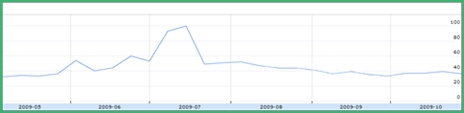
Since the events in western China in July, people have had no access to Twitter. Afterward many third-party applications and client sides of Twitter were blocked too. But Twitter didn’t actually leave us. We can take a look at the statistics from Google Insight, and here’s the curve of the search volume of “twitter” between June and October:
Except July that is special that we don’t discuss, the search volume of Twitter didn’t drop and there are still many Chinese people using Twitter.
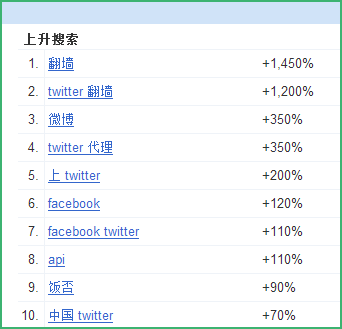
We can also see the drastic increase of the search volume of keywords related to Twitter through Google Insight, like the ones below:
Growing Searched Words
1. climb over the Wall +1.450%
2. twitter climb over the Wall +1.200%
3. micro blog 350%
4. twitter proxy +350%
5. log onto twitter 200%
6. facebook +120%
7. facebook twitter +110%
8. api +110%
9. fanfou +90%
10. China twitter +70%2. Stories of Twitter and me
This story is not discussing the marketing of Twitter, nor the application of Twitter, but several stories of Twitter and me. My Twitter account is: @jason5ng32
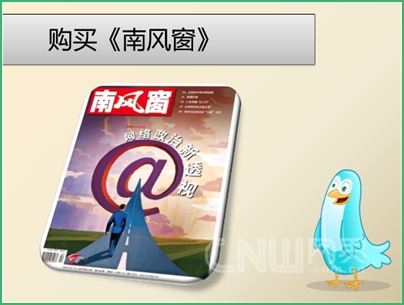
(1.) Buying Nan Feng Chuang Magazine (South Wind Window)
The latest issue of “Nan Feng Chuang” had a series named “New Perspective of Internet Politics”, the sensitive content of which excites a lot of people. Many twitterers started spreading the content after Netease’s post of this series was deleted. Seeing more and more people recommending this issue of “Nan Feng Chuang”. I decided to buy one too, both for collection and reading.
I’ve been to all the newsstands around my home, yet “Nan Feng Chuang” was either sold out or unheard of.
What should I do?
So I sent out a tweet on Twitter asking if people in Beijing can buy one copy of “Nan Feng Chuang” for me. After less than two minutes, two twitterers said they could buy one for me. @pen9u1n even bought one for me that day.
@pen9u1n I’ve never seen this ID. We’re strangers to each other to a some extent, but he’s willing to offer help, and I’m very glad to accept it. Just think, is there any other tool to replace Twitter that can help me buy “Nan Feng Chuang”?
If asking a friend of mine, he’s probably unavailable to buy it for me. If asking around on my blog, when people go out to buy it after reading my blog, perhaps “Nan Feng Chuang” would have been sold out around the country already.
(2). Asking for help
When we encounter a problem, we’d probably seek the answer through a search engine. Yet it’s difficult to find the answer of some questions that are not on the Internet.
However, Twitter can help you.
I’ve for many times asked for help on Twitter, like asking how to configure a certain application of Windows, which website has the most reliable host computer, etc., and twitterers are very eager to help. And those who don’t know the answer are also willing to help by retweeting my question so that more people can see, thus my problem could be solved sooner.
(3). Meal appointment
During weekdays, in order to keep fit, I’d usually go out for lunch.
However, it’d be boring eating alone. If asking my colleagues to eat together, sometimes they might have an appointment or would rather to order take-out food. I’ve asked a female colleague twice to have lunch together but was rejected. So then I don’t have the guts to ask again.
Afterwards I don’t have to worry about eating alone any more. When I wanted to find someone to have meals with me, I’d ask on Twitter, “Who’s interested in having lunch together at…?” Twitterers who’re interested would reply to me so we would schedule a time to have lunch together.
Through this way of inviting people to meal, I’ve met several new friends, like @xuyuan0466. Without Twitter, perhaps I would have to eat alone every day, or perhaps I would order take-out food, which would stuff my belly bigger. Twitter to some extent can help me keep fit.
(4). Citizen reporter
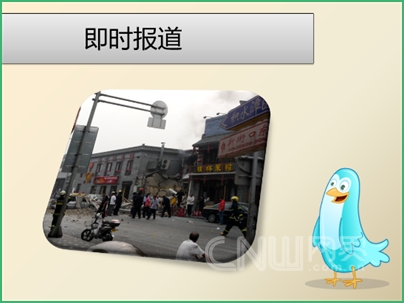
Readers might have an impression on the picture above. This is a picture taken by an American twitterer. It shows the explosion at a Xinjiang restaurant around Jishuitan in Beijing. The American twitterer happened to be at the scene so she uploaded the picture to the Twitpic.The picture was then widely retweeted by many twitterers. Since the explosion took place at dawn of the celebration of the 60th anniversary of PRC’s founding, and the event contains the sensitive word “Xinjiang”, twitterers were retweeting it pretty actively. Afterwards people couldn’t even visit Twitpic.
Just like the lesson brought by the fire of CCTV, the picture has also brought me some thoughts. Foreign news outlets have reported many cases of citizen reporters using Twitter to report a certain event, most of which happened outside China. Yet this time I truly perceived the fascination of Twitter as a media.
Everybody can use Twitter, or micro-blogs, to report the events happening around. Once something happens, one can pick up his cellphone to take pictures and upload to the Internet through various Twitter client sites, and other twitterers will soon learn about the event. The network of Twitter is connected in multiple ways. As long as someone is following you, you may be a citizen reporter and cover the events around. It’s fast and real, which Xinhua News Agency and People’s Daily Online can never achieve.
5. Love through Twitter
As many readers may know, I’m in a relationship with maoz. Like I said in the previous post “Internet that tends to be real”, we developed most of our relationship on Twitter.
Blogs provide an approach to know an individual yet this is not enough, as the update on a blog is slow and it doesn’t have an active interaction. But Twitter is different. I’d send many tweets every day, and would @ back and forth with other twitterers. If you want to learn about someone on Twitter, just simply search his Twitter ID. What he’s said, and what others have said to him, is all clear at a glance.
Therefore, the two of us learn many aspects of each other through Twitter, like hobbies, statements and actions, sense of worth, etc., which cannot be achieved by other means. Twitter at some degree makes the Internet more real, and returns the virtual society back to reality.
I’ve read a lot of such news, some blogger met a pretty girl through QQ yet only to find out it was a guy when they met, and even got robbed by the guy. Developing a relationship through QQ may deceive you, yet the relationship on Twitter is real.
3. What has Twitter changed?
The above several cases look simple, yet these are what an ordinary blogger has managed to do through Twitter, which cannot be done or perfectly done on other platforms. A summary of what Twitter has changed follows:
(1). Lifestyle
First of all, Twitter has changed my lifestyle. To follow my friends’ status and the latest focus, I’d often unwittingly open Twitter on my cellphone to see what my friends are talking about, and whether there’s any breaking news, and meanwhile share what I know.
(2). Form of communication
Twitter has also changed the way I communicate with others. Seen from some of the examples above, the communication through micro-blogs is different from that through blog and chat tools. It’s a semi-public broadcasting pattern with a simultaneous existence of one-to-many and one-to-one model, which is very creative.
(3). The way to ask for help
Rather than posting on the BBS to ask for help, I’m inclined to ask on Twitter and most of the time someone would know the answer. Even if no one knows, he would retweet to help me. People in the Chinese micro-blogosphere are very warm-hearted.
(4). More responsibility
The characteristics of micro-blogs—timely and quick circulation—bring me the courage to be a citizen reporter. Not to discuss the professionalism of a citizen reporter, I’d rather play the role of a third person using Twitter, to share what happens around or gossip with other twitterers. In other words, I’ve got more responsibility.