

In this recent censored post, current-affairs blogger Wei Chunliang expresses alarm at reports of a kindergarten sports day featuring homemade mock explosives, part of a broader trend in “red education.” The post comes amid commemorations of the 90th anniversary of the Long March, a key episode in Party history and mythology. The parcel-like examples pictured online also evoke a celebrated incident later in the civil war, in which teenaged PLA soldier Dong Cunrui is said to have sacrificed himself by holding an explosive pack in place against a Nationalist fortification as it detonated. Wei does not challenge the fundamental premise of "red education," and even proposes alternative, non-explosive-based ways of pursuing it. The post was censored regardless.

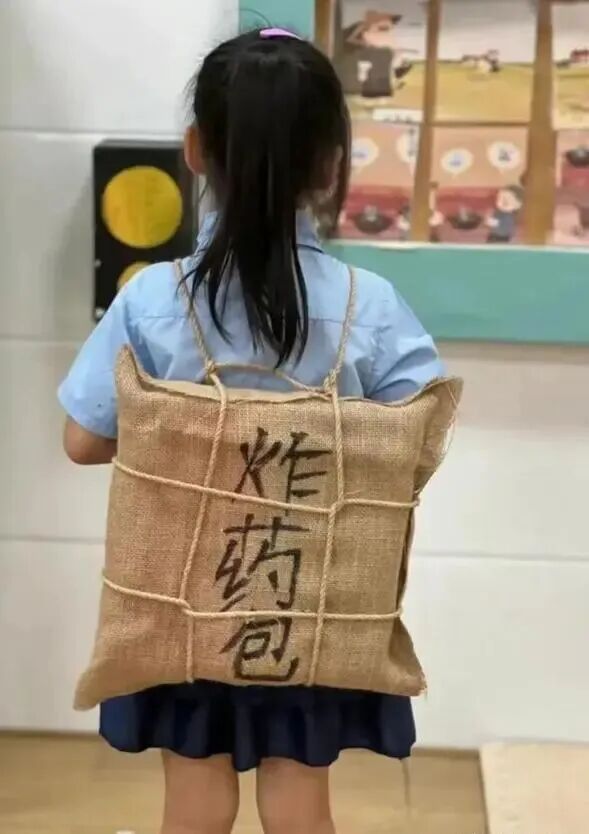
The pack is labeled “explosive pack”
"Explosive packs" are a disconcerting sight at a kindergarten, even if it’s all just a game.
A kindergarten in Wuhan held a sports day with the theme "Little Red Army Soldiers on the Long March." They asked parents to make a simple "explosive pack" for each child, to ensure a more immersive experience.

__ Kindergarten __ class work group (__)
@ All members
Dear parents, good evening!
The theme of our kindergarten’s next sports day will be “Little Red Army Soldiers on the Long March.” We request your help with two pieces of preparation to help the children immerse themselves in the activities:
1. Dress code: Please prepare a white top, black pants, and sneakers for your little darlings to wear for the day’s activities.
2. Handmade materials: Each child should make a simple explosive pack. (These can safely be made by hand using everyday materials like cardboard, fabric, newspaper, etc. It just needs to be safe and light, for use in the sports-day roleplaying activities.) Once completed, please bring it to the kindergarten by next Thursday.
Thanks to all parents for your cooperation.The kindergarten thoughtfully provided reference photos in case any of the parents had never seen an explosive pack. The photos showed little tykes carrying homemade explosive packs on their backs, the props forming a jarring juxtaposition with their youthful bearers.

Explosive packs labeled “Explosives” or “Explosive pack.” The last one adds “Long live the People’s Republic of China.”
As you can tell from the photos the kindergarten provided, there’s nothing new about getting kids to make explosive packs. It’s become quite a trend.

Daughter off to school with her “satchel charge” on her back, showing it off to classmates.
It took half an hour to make. The kid loves it.
She’s even showing it off to the other kids!Of course, I can understand the kindergarten’s original intention with this activity: “red education” should start early, and they want to give the children an immersive experience of the history of the Long March, so they can carry on its spirit.
Some might argue that this is just historical reenactment to help kids understand the spirit of the Long March, and it’s done with the best of intentions.
The problem is that good intentions don’t always mean appropriate methods. You can’t just look at motives in education, you have to look at what’s actually getting through to the children.
Explosive packs have never been normal playtime props. They symbolize a type of weapon tightly bound up with death, injury, and the brutality of war.
Kindergarteners are still so young; they can understand that "friends should help each other" or "you should keep going even when you’re tired," but they can’t be expected to grasp abstract concepts like "the weight of a human life" or "the brutality of war," still less that an explosive pack’s detonation often results in death on both sides.
Once historical education exceeds children’s capacity to understand it, trying to make it more vivid may just take it further from the original intention, and from the truth.
So I don’t understand what strapping explosive packs to the backs of kindergarteners is actually supposed to achieve. Is it really about helping them understand the spirit of the Long March?
The core of that spirit is about tenacity in a hopeless situation, unity in dire circumstances, and unyielding faith. It’s about an indomitable journey across grasslands and snowy peaks, and the warmth of mutual aid between soldier and civilian.
None of these values need be communicated by making explosive packs and putting them on the kids’ backs.
Remembering history has never been a matter of recreating martial paraphernalia, still less making children reenact battle scenes.
Having children handcraft mock-lethal items out of newspaper and cardboard, then play games with them strapped to their backs essentially takes a grave symbol of war and normalizes, cutesifies, and gamifies it.
Children can neither perceive the death that lies behind the explosive pack nor understand the justice or injustice of war. The most direct lesson they’ll draw from it will be simply, "Oh, turns out war’s just a game you play with an explosive pack on your back."
When the gravity of history is lost in all the running around and giggling, and something representing weaponry becomes a fun sports-day prop, rather than learning a lesson about greatness of the Long March, kids might just come away with a flippant attitude toward war.
This has absolutely nothing to do with reverence for history, or commemoration of it—not a thing.
Worse yet, it oversimplifies history to reduce all the Long March’s complexity, struggle, and spiritual depth to an explosive pack on a kindergartener’s back. It’s educationally irresponsible.
But none of these issues are what I find most worrying. What we should be even more on guard against is the mentality behind this style of education.
Early education should be built around nurturing love and kindness, conveying a sense of security and rudimentary knowledge of the world, and fostering basic life skills and empathy.
In terms of red education, of course there’s a place for it in kindergartens, but it must match the kids’ cognitive level.
If you want children to experience hardship, then design endurance games about "crossing the mountain ridges." If you want them to understand mutual assistance, plan cooperative tasks like carrying stretchers, building bridges, or transporting goods. If you want them to know how hard-earned our modern lives are, tell them heroic stories, show them picture books appropriate to their age, and let them experience manual labor within their capabilities.
All these methods can plant the seeds of patriotism without prematurely pushing symbolic weaponry on children.
Introducing children to history will often be counterproductive if it’s not done professionally. Making children play war games with explosive packs on their backs at an age when they can’t even understand what war is or what death means won’t instill devotion to their homeland, it’ll just make them accustomed to symbols of violence.
We always say we must teach children to understand the value of peace, but the first step in that should always be to keep them away from symbols of war, not to assign arms manufacture as handicrafts homework.
Spending your energy on getting children to make explosive packs shows a warped understanding of the essence of early childhood education. What kind of adults will our children grow into if their education is based on ideas like this?
Please consign the weapons to history, and restore gentleness to childhood. Stop hassling parents, and stop warping children’s minds! [Chinese]