


Late last month, veteran environmental campaigner Zhang Wenbin was detained in Xinjiang, where he lives and works, by police who had made the long trip from Jiangxi. Many aspects of Zhang’s detention echo those of citizen journalists Liu Hu and Wu Yingjiao in February. Their case similarly featured cross-border detentions, official opacity, and allegations of “extortion” widely suspected to have been fabricated to silence their online whistleblowing. Liu and Wu’s detentions, like Zhang’s, triggered a flurry of online activity including updates, legal analysis, endorsements of their work and character, and hopes for their swift release. In both cases, much of this content was swiftly and aggressively censored.
According to the Aquarian newsletter, two local environmental volunteers, Luo Wenbin and Xiong Qu, were also detained last month in connection with Zhang Wenbin’s case. Although lawyers were able to meet with Zhang on October 27, The Aquarian reported, police denied a subsequent request on November 6. The post, partially translated below, portrays Zhang as a dedicated and scrupulous investigator, and notes his association with serially detained performance artist "Nut Brother" — the two worked together in 2021 to reframe a polluted waterway as an unappetizing "hotpot broth" filled with inflatable fish. The Aquarian places Zhang’s detention in the context of broader challenges facing environmental activists in China today:
News of Zhang Wenbin’s detention drew widespread attention in Chinese public interest circles not only because of the accusation against him, but also because of Zhang’s personal influence as the driving force behind the WeChat account "Zero Distance." Most of the account’s 183 surviving articles are exposés of industrial pollution in various places written by volunteers based on field investigations, with subsequent follow-up.
The types of environmental pollution exposed are mainly excessive emissions of exhaust gas and sewage by industrial parks; noise and dust pollution from production processes; improper storage of industrial waste; the unauthorized burning, dumping, or burying of pollutants; illegal tree-felling, and so on. "Zero Distance" also tracks illegal hunting, excessive heavy metal content in soil, contamination following factory explosions, and other topics.
[…] People like Zhang Wenbin are gradually changing careers, unable to sustain their ideals in the face of high risks and low pay. For over a decade, Li Ying has witnessed many environmental protection volunteers growing disheartened after repeated setbacks, and dejectedly leaving the field. Fang Mengyi says that economic resources are very limited for public interest organizations working in industrial pollution, Zhang’s field. Money from crowdfunding mostly flows to bigger organizations, foundation grants tend to favor larger-scale organizations, and smaller public-interest organizations find it hard to obtain funding even if their work is outstanding. Naturally, with little money raised, public-interest organizations can only offer low salaries.
Fang Mengyi believes that family members are a major factor in the dispersal of volunteers. Relatives may try to stop them due to worries about the continuous threats and attacks facing both volunteers and themselves, and they may be reluctant to offer emotional support. Fang no longer conducts industrial-pollution investigations, and has moved to other less perilous environmental-protection fields like habitat restoration and species conservation.
"There’s not much public support for the idea of paying people salaries to do public-interest work," Fang Mengyi said, adding that environmental investigation and pollution exposure work doesn’t enjoy much public visibility. It’s not like forms of material public interest work, where donors’ financial contributions can be exchanged for physical goods that are delivered to those in need. Environmental protection workers are caught in a vicious cycle in which they’re "not allowed to be seen" and also lack financial support.
[…] Tian Xi indicates that in recent years, environmental protection volunteers have often been detained, frequently on charges of "extortion" or "picking quarrels and provoking trouble." Fang Mengyi told The Aquarian that nearly all the active environmental protection volunteers in her circle have been detained at some point, including herself. "It’s more surprising when it doesn’t happen."
[…] In 2015, Henan farmers Li Xu, Li Dongzhi, and Li Jixian were sentenced or [convicted but] exempted from criminal punishment for extortion after they reported environmental pollution by a business near their village. After seven years of petitioning, the three finally obtained a written decision from the procuratorate, declaring them "not guilty, not subject to prosecution." Zeng Xiangbin, Li Xu’s legal counsel for the petition, wrote in a 2021 article: "Generally, every year there are cases of environmental whistleblowers being framed by local governments."
In an interview, he explained why this happens: "When a business is reported for polluting the environment, it’s not that the polluting business itself feels pressured and hits back; it’s that the local bigwigs feel they’ve lost face, so they cook up some way of painting the polluting business as a ‘victim’ of extortion. And the local cadres responsible for brokering the settlement turn around and become ‘perfect witnesses’ for the police investigators."
[…] Lin Wei says: "Our rights and interests will be mercilessly tossed aside if we really come into opposition with the government." As a result, she advocates pursuing environmental-rights defense through normal legal channels, and making sure not to overstep if people do take to marching in the street. "We can’t have 100 people going out and only 96 coming back." But this viewpoint also exposes the various dilemmas for the government and the public when facing pollution problems. If those issues cannot be thoroughly resolved, conflict will inevitably erupt between the relevant departments and the masses. Once that happens, the government will violently suppress public protest, and people already suffering the effects of environmental pollution will have even less faith in official action.
[…] Those wanting to help him [Zhang Wenbin] are also constrained by the current media environment. Zeng Xiangbin, the lawyer, wrote in the previously mentioned article that in cases like this, "There must be sustained support, exposure, and publicity." But based on Tian Xi’s observations, there are now far fewer media organizations that can follow up and report on detentions of environmental-protection volunteers than in the past, and some cases don’t get any mainstream media coverage at all. He revealed to The Aquarian that he’d been in touch with some domestic media outlets, but as soon as he sent them details, the outlets replied that this kind of topic had absolutely no chance of making it to print. [Chinese]
CDT Chinese archived a number of posts related to Zhang’s detention, several of which were subsequently deleted. An October 21 post announcing the detention, from the Green Waters and Lush Mountains Research Team, was deleted despite its painstaking evenhandedness, repeated warnings against speculation or premature conclusions, and strong insistence that environmental activism must remain within the law. Another post on the same day came from WeChat account The Situation Is Quite Complicated, explaining Zhang’s past activities and previous involvement in Wanzai, and discussing the several days of driving that must have been involved in seizing him from Xinjiang and taking him back to Jiangxi. This post was also deleted, as were two follow-up posts from the same account. The first was an interview with Zhang’s sister about his detention, personality, and his family’s concern for him, combined with a series of flyers serving the dual purposes of highlighting his detention and helping find him a wife. These are adorned with enticing slogans including: "Years of privation cannot conceal his handsomeness and vigor!" "Possessing both outstanding talent and an air of danger, this young man can withstand the relevant departments’ trials!"
Another post from The Situation Is Quite Complicated began with an accurate prediction of its own swift deletion before recounting a conversation with older environmental activist Zhang Zhibiao. Zhang Zhibiao described how he was initially unimpressed with Zhang Wenbin’s timidity, but grew to respect his dedication and the quality of his work. Zhang Zhibiao said Zhang Wenbin had once told him, "If I ever get arrested, it’ll be an act of retaliation." Zhang Zhibiao, who has himself suffered detention in the past before being released without charge, answered, "Frankly, if they’re hell-bent on malicious retaliation, they can make trouble for you even if you haven’t done anything wrong."
A lengthy post from legal blogger Li Yuchen on October 23 was also deleted. Li offered a detailed account of Zhang Wenbin’s work and previous run-ins with the authorities and the targets of his investigations, before providing a legal analysis of his current predicament and the lines between environmental whistleblowing and criminal extortion. Li reports that Zhang’s family received formal notification of the detention on October 23; perhaps as a result of the censorship surrounding the case, some later posts by others continued to describe Zhang’s whereabouts and legal status as unknown.
On October 24, the WeChat account Kang Kang’s Curious Notes (康康的好奇心笔记, Kāng Kāng de hàoqíxīn bǐjì) published the following short-lived post describing the author’s acquaintance with Zhang Wenbin and hopes for his safe release:
I want to write something a bit different today.
Recently I learned from my WeChat Moments that environmental-protection volunteer Zhang Wenbin has been taken away by police from Wanzai, Jiangxi province. According to his family, the police said he is suspected of extortion.
I got to know Zhang Wenbin through the Xiangshui explosion in 2019. He’d long been following pollution problems at chemical industrial parks, and traveled to the site of the explosion almost as soon as it occurred.
I got in touch with him on the recommendation of "Colorful Earth" founder Zhou Jiangang. We never met while I was reporting from Xiangshui, and after a few days, I was called back to Beijing, and couldn’t do any more reporting from the scene.
Four days after the explosion, on March 25, I heard that Zhang had been taken away by Jiangsu police. I called the local police to verify this, and wrote up a report about it. He was released that afternoon. The police summons said he had been questioned on suspicion of "picking quarrels and provoking trouble" because he had posted content about the center of the Xiangshui blast zone online.
Three years later in Jiangxi, we met offline for the first time. I’d gone there to report on sluice-gate construction at Poyang Lake, and was attending a public hearing on the environmental impact assessment of the Poyang Lake water control project. He was also visiting the site with volunteers from Let Migratory Birds Fly and a few others.
Zhang, tall and deeply tanned, drove us all around. I joined them on a loop around the lake, and interviewed villagers, former fishermen, local organizations for protection of the Yangtze finless porpoise and migratory birds, and so on.
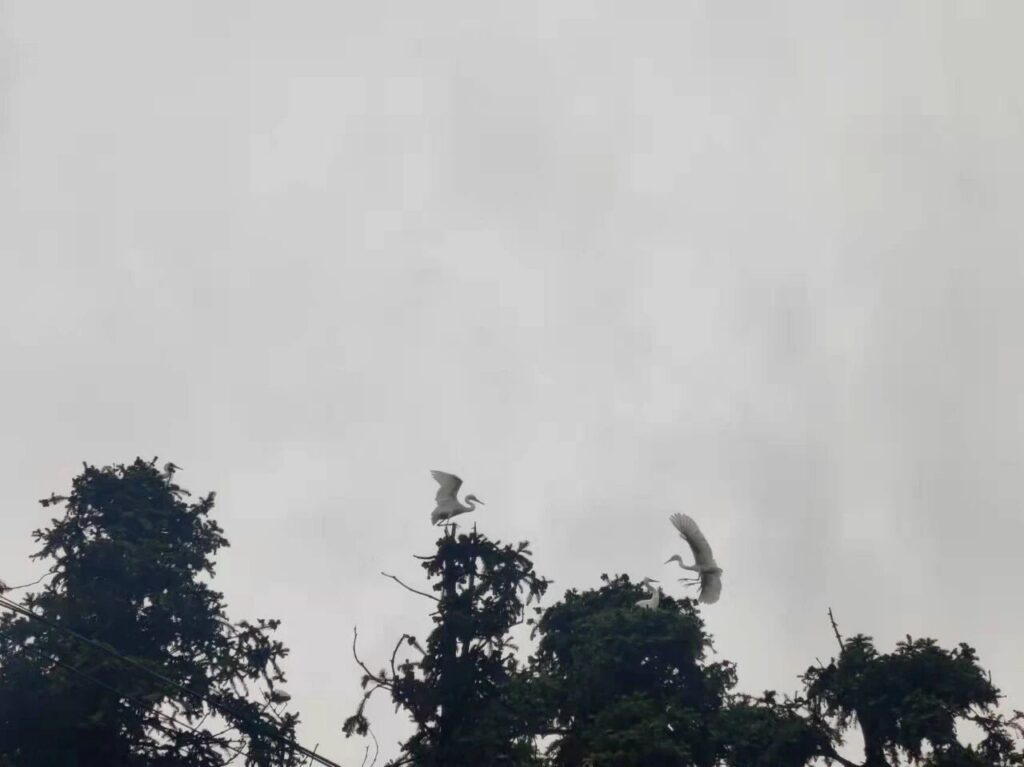
On our way, we passed the Xiangshan Forest Park in Nanchang. It happened to be the egret breeding season, and we all ascended several flights of stairs in a nearby building to get a better view. The vista that opened up before us revealed a dense mass of egret nests, and the egrets – ethereal in their breeding plumage – perched as gracefully as martial arts masters on the branch tips and treetops. It was the kind of scene that makes me feel lucky to be alive.
Maybe it’s moments like this that inspire a lot of environmental-protection volunteers to choose a life of undercover investigations and campaigning.
Zhang Wenbin’s main focus is pollution at chemical industrial parks, and he has been involved in field research at many sites, such as the Xiegou Coal Mine in Shanxi. I’ve met more than a few volunteers, and many of them are passionate and garrulous, but Zhang’s an exception. He’s extremely reserved, hardly saying a word except when asked a question, and listening in silence when others speak.
During the trip we were tailed by a car with a local Jiangxi plate, which got us talking about the predicaments of volunteers and journalists. I said that journalists are relatively protected: in the event of any conflict, they have institutional support to help smooth things over, so their physical safety, at least, isn’t as big a concern. But many volunteers work independently, with no "backup."
Zhang Wenbin didn’t see it that way. He felt that he was doing the right thing, and knew how far he could go. And if he ever did fall into conflict or danger, there were a lot of colleagues, partners, and media there to offer "backup." So he, too, felt that he was fairly safe. I chuckled inwardly at this, but also felt a flicker of admiration that he hadn’t been cowed by the [political] environment shifting around us.
The reality is, though, that I was the only one on that trip who wasn’t contacted by or given some sort of warning from Jiangxi police. This time, as it happens, it’s Jiangxi once again. But because no formal detention notice has been issued yet, and Zhang hasn’t been able to meet with a lawyer, we don’t know the specifics of the case.
I hope he’s safe and well. [Chinese]
CDT archived two posts from WeChat account Return to Wilderness (回归荒野, Huíguī huāngyě): one from October 23, titled "Zhang Wenbin, well known for his decade of voluntary work in environmental protection, has been taken away by public security, and his current circumstances are unknown"; and another from the following day, titled "On Zhang Wenbin (Reposted after deletion: where did it break the rules, may I ask?)" The latter is essentially a revised version of the former, with changes made in an apparent, unsuccessful attempt to avoid a second deletion. For example, every mention of "police" in the original post is replaced with "**" in the second. Elsewhere, though, the revised post expands on the original. The text below combines the two versions, with deleted sections in italics and new sections in bold. Other text is the same in both versions. The two posts are illustrated with photos of Zhang at work. Some photos are the same, and some different, without any clear reason. They are omitted here, but can be viewed at the source links.
Zhang Wenbin is an environmental-protection volunteer with a long history of frontline investigations into environmental pollution, with particular expertise in pollution at industrial sites. He has been involved in investigating and intervening in industrial pollution for more than ten years.
Zhang Wenbin, from Tacheng, Xinjiang; male; Han Chinese; born in 1989 (his ID card says 1988). Attended university in Nanchang, Jiangxi province. Since his university days, has participated in many public-interest activities such as protection of birds on Poyang Lake. Later worked with Zhang Xiang in Beijing on the Leshuixing [river monitoring] project, then on a series of pollution intervention actions such as the Tengger Desert pollution case. Since then, he has focused on public-interest investigation and intervention activities related to industrial parks.
He has been engaged in public-interest environmental work since university, and has never worked in business or commerce. He has remained single; because he’s not getting any younger, his family summoned him back home at the end of 2025 for the purpose of finding him a good match. In 2026, he found a position doing environmental impact assessment work in Xinjiang, which allowed him to protect the environment in a different way.
He’s a fairly guileless person of few words. He only speaks freely with those he knows well, but is well-liked and highly regarded. Because he began public interest work straight after graduating, he is socially inexperienced, which naturally makes him vulnerable to being manipulated or taken advantage of by others.
A few of the incidents he has been involved with:
2015: Fell out of contact while volunteering for Leshuixing — Zhang Wenbin and another volunteer were taken away by Beijing police ** while preparing to photograph a sewage outlet into the Wanquan River near the East Gate of Peking University.
2019: Received a summons after visiting the site of the Xiangshui explosion — After the explosion at the Xiangshui chemical industrial park, Zhang Wenbin immediately rushed to the scene to investigate pollution at the site, and soon fell out of contact. Xiangshui police ** confirmed that he had been taken in for investigation; Zhang himself said he had been summoned on suspicion of "picking quarrels and provoking trouble," and was released that afternoon. The police ** found two ID cards in his possession. (A friend explained that Zhang had obtained a new ID card after moving from Gansu to Xinjiang, but had kept the old one.)
2023: Beaten while investigating the Xiegou coal mine — Zhang was commissioned by the environmental protection organization Friends of Nature to conduct a site survey at the Xiegou coal mine in Xing county in Shanxi’s Lüliang city. He took photos of the mine discharging black wastewater into the Lanyi River, a tributary of the Yellow River. Soon afterward, he was beaten in a clash with personnel from the mine, and his vehicle was also damaged.
According to a notice from Xing county police **, their investigation found that Zhang Wenbin’s vehicle brushed against worker Hu ___tao as Zhang was driving away. In the ensuing argument, gangue dump worker Wu ___ assaulted him. Wu was placed in administrative detention and fined. But Zhang objected to the content of the notice, saying that the argument began when the other party tried to force him to delete the photos and video he had taken, and that he did not notice anyone behind his vehicle when he started reversing. This Xiegou coal mine had already twice been written up by an ecological and environmental protection inspection team from the central government for making only perfunctory rectification efforts and inflicting grave ecological harm. Friends of Nature had already filed an environmental public-interest civil lawsuit against the mine in 2021.
In 2023, CCTV’s Focus Report reported on the heavy metal contamination of 1,000 mu [165 acres] of Jiangxi farmland, a case that Zhang Wenbin had helped draw attention to.
October 2026: Taken away in Xinjiang — according to his family, Zhang Wenbin was taken away by police from a certain location in Jiangxi while he was in Xinjiang. Zhang Wenbin was taken from Xinjiang by **. The precise cause is unknown, but it may be connected to his earlier intervention involving a certain business in Jiangxi’s Yichun city [which includes Wanzai county].
In 2025, Zhang actually returned to Xinjiang because of financial pressure, and found work related to environmental impact assessment.
Zhang Wenbin is a fairly honest and dependable person who’s been in environmental protection for more than a decade, doing frontline industrial pollution investigations and interventions throughout. Thin and tall, he has never had a girlfriend. He leads a fairly hard life, and has a deep tan from his years out in the sun. Many of his interventions have been formally taken up by environmental authorities, with numerous cases covered by mainstream media, and some even receiving follow-up reporting by CCTV’s Focus Report and other outlets.
It’s currently unknown why police took Zhang Wenbin away. We await the official police notice for details of the situation. We urge everyone to please refrain from spreading or starting rumors. We look forward to the relevant public security departments clarifying the situation, and hope that Zhang Wenbin is safe. Come home soon. Finally, we believe that the rule of law and regulation is fair and just, and hope Zhang Wenbin will soon return safely. [Chinese] [Chinese]