


The recent 33rd Asia Pacific Economic Cooperation (APEC) Economic Leaders’ Meeting was strong on pageantry and photo ops but short on concrete results. For residents in the southern Chinese metropolis of Shenzhen, where the meeting was hosted, it was preceded by a month of heightened security measures affecting many aspects of their daily lives.
The security crackdown, which began in late October, included nightly fire-department inspections of urban villages and entertainment venues; police chaining up knives at a local restaurant; increased scrutiny of all mail and packages sent to Shenzhen; the banning of mailing and delivery of certain items, such as knives and sharp tools, into the city; police sentries stationed on nearly all overpasses; and more frequent random street searches of passersby and screenings of public-transportation passengers. Neighboring cities launched a “Shenzhen Moat” operation that involved searching and recording information on every vehicle headed into the city, while police enforced a strict no-fly zone for drones to secure Shenzhen’s low-altitude airspace.
CDT Chinese editors have put together a compilation of these APEC-related security measures, based on various news reports, social media posts, and reader submissions to Li Ying’s “Teacher Li Is Not Your Teacher” X account:
The 33rd APEC Economic Leaders’ Meeting was held in Shenzhen on November 18 and 19, 2026. During the preparations for the meeting, Shenzhen and surrounding areas implemented high-level security measures, which officials described as “a decisive stage in the battle," a kind of wartime footing that called for "using area-wide control to secure key locations, and securing the wider area via key locations." This involved putting large numbers of police on the streets and setting up strict control perimeters around Shenzhen. Many netizens wrote posts or submitted content to platforms (such as Teacher Li’s X account) describing the impacts of specific security measures on their daily lives.
Nightly Citywide Fire-Safety Inspections
From October 25 to November 20, both before and during the APEC meeting, the Shenzhen fire department carried out nightly citywide fire-safety inspections with a focus on “urban villages,” privately constructed commercial buildings, "three-in-one" structures [multi-use structures that combine residential space with production, storage, or commercial spaces], as well as hotels, restaurants, and entertainment venues.Restrictions on Knives, Hardware, and Tools
On October 30, the proprietor of Jiudaogeng Whole-Beef Banquet, a restaurant in Shenzhen’s Longhua District, reported that the restaurant’s kitchen knives had been secured with chains by the police, who personally came to install the chains. The proprietor also said that they’d heard the knife-chaining policy was implemented community-wide. At around the same time, netizens in multiple locations reported that knives, metal tools, nail clippers, and certain other items purchased online could not be shipped to Shenzhen.Restrictions on Postal and Express Delivery
From November 1 to 22, the Guangdong Provincial Postal Administration imposed temporary security measures, including X-ray and other screening methods, on postal and express packages bound for Shenzhen. Delivery services for packages containing certain “non-compliant items” were restricted, and recipients were cautioned that there might be delivery delays. There were also reports of prohibitions on items such as high-pressure cylinders, powders, and knives being sent to Shenzhen.Heightened Security Checks of Passersby and Passengers on Public Transport
On November 3, a netizen posted a video of police and security personnel staffing a security checkpoint on a street in Shenzhen, and of passersby emerging from the checkpoint after their bags and belongings had been X-rayed.On November 16, a resident reported that police officers had been posted on nearly every overpass and pedestrian footbridge in Shenzhen, and in the nearby cities of Dongguan and Huizhou. Pedestrians were prohibited from loitering or taking photos, and passersby on overpasses were subject to random searches of their persons and bags. Cities around Shenzhen launched the "Shenzhen Moat” operation, setting up security checkpoints on all roads leading into Shenzhen, and requiring all vehicles and passengers to be searched and registered. The resident noted that the checkpoints were causing severe congestion during evening rush hour.
On November 17, a passenger filming a “day in the life” video on the Shenzhen Metro was questioned by metro staff. She clarified that her video didn’t touch on any controversial societal issues and asked, “Is security really tight right now?” Other residents reported more stringent security checks at metro stations and long lines at security checkpoints.
Restrictions on Photos and Video Near APEC Venues
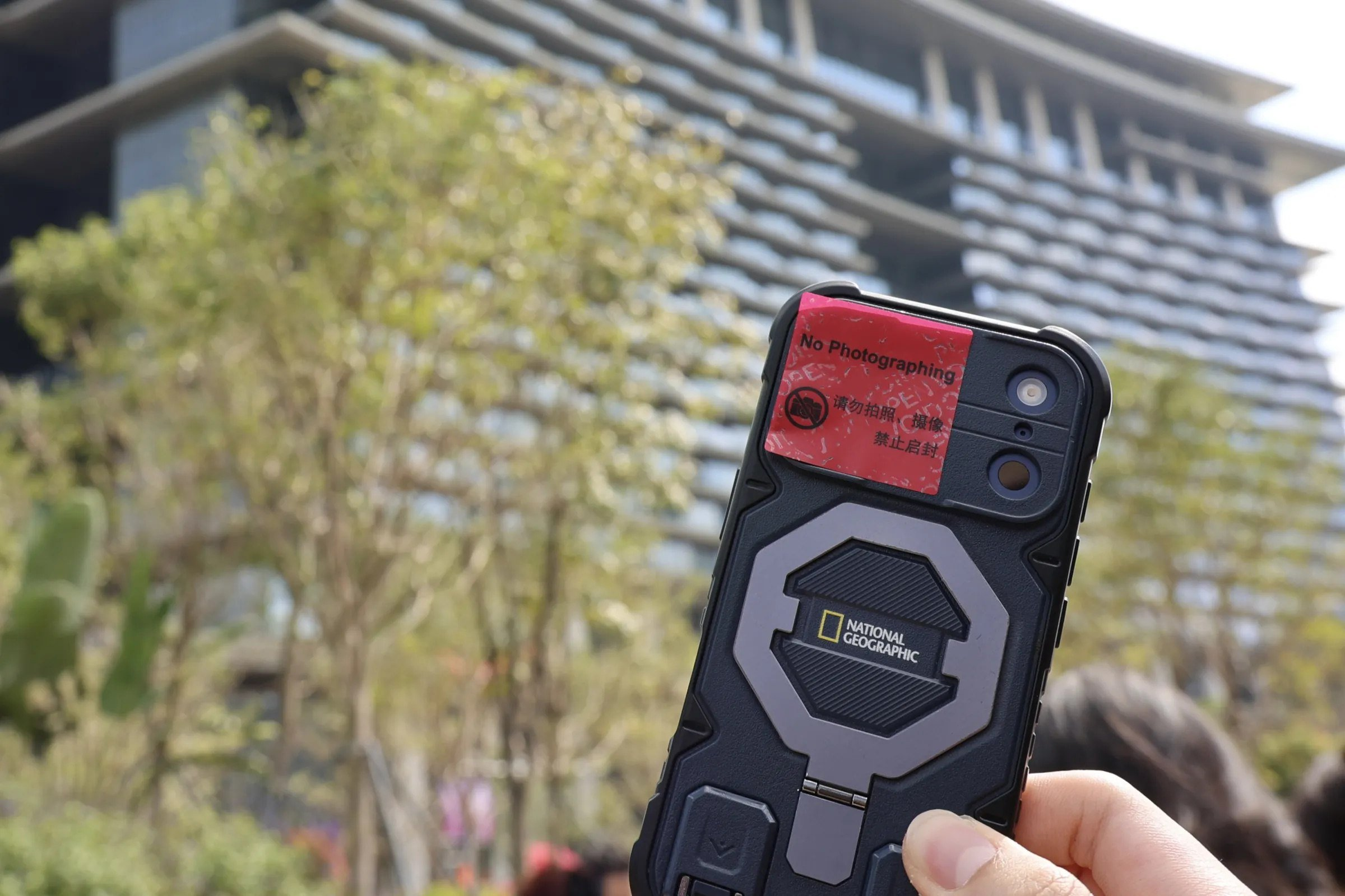
On November 16, Taiwanese reporters in Shenzhen to cover APEC noted that plainclothes officers were stationed every few meters along the perimeter of the Qianhai International Convention Center [where the APEC CEO Summit was held]. Anyone taking photos or video in the area was stopped and questioned. One Taiwanese reporter said she was asked to show her credentials and forbidden from continuing to film. At the Shenzhen International Exchange Center, the main venue for the APEC Economic Leaders’ Meeting, all media personnel entering the restricted area were required to affix red stickers to the front and rear cameras of their mobile phones. According to reports, if the red stickers were removed without permission, they would leave behind white text reading "OPEN VOID," allowing security personnel to detect that the stickers had been removed.
A mobile phone with a red sticker cautioning, “No photographing.” (source: X @whyyoutouzhele)
On the afternoon of November 17, a journalist from Hong Kong news outlet HK01 arrived near Kylin Villa in Shenzhen’s Nanshan District to report from the scene. As soon as she emerged from the car, on-site staff inspected the journalist’s mobile phone and told her to delete some photos that they described as dealing with "classified” information.
Restrictions on Traffic and Daily Activities
On November 17, Reuters reported that some local parents were worried about childcare, since primary and secondary schools in Shenzhen were given a four-day autumn break for the summit, while parents went to work as usual. Roads near the venue were subject to various closures, and some residents were unable to drive to work during the week. A number of districts placed restrictions on passenger vehicles with non-Shenzhen plates; sections of some roads in central areas were closed at certain times; and drones and kites were banned throughout the city.Reuters reported on some of the disruptions to daily life caused by APEC in Shenzhen, including schools being closed for four days, while parents were expected to go to work as usual. […] On November 17, Reuters reported that tens of thousands of people in Shenzhen, including security guards at residential compounds, were required to wear red vests printed with the English word "Volunteer" before and during the APEC summit. A security guard in Nanshan District said that his boss told him to wear one of these red vests, despite the fact that he couldn’t understand the word printed on it. "I don’t speak English," the guard told a reporter from Reuters. A Shenzhen office worker said her company had reminded employees not to wear clothes with English printed on them if they couldn’t understand it, to avoid displaying any English-language profanities. Before the summit, Shenzhen instituted a citywide ban on honking, with fines starting at 300 yuan ($45) per violation. Over 1.5 million local car owners pledged not to drive during APEC, and food-delivery platform Meituan suspended drone delivery for 10 days. A resident living near the venue said that she wasn’t able to drive to work during the week, due to frequently scheduled road closures.
Construction Work Suspended
On November 17, BBC Chinese reported that a construction site in northeastern Shenzhen, despite being located more than ten kilometers (six miles) from the main APEC venue, had been ordered to suspend work for nine days. The workers received no compensation and were required to stay in their dormitories and verify their location by submitting daily selfies marked with the time and location.Fenced-Off Hotels
On November 17, a resident took video of the exterior of the Conrad Shenzhen Hotel, where Russian President Putin was reported to be staying. The video showed extremely tight security, with numerous guards, portable fences and barriers, and high sheet-metal fencing blocking off the hotel.On the evening of November 17, a reporter from Hong Kong media outlet HK01 noted that the Langham Hotel in Shenzhen’s Futian District, where U.S. President Trump was expected to stay, had been surrounded by sheet-metal barriers. Armed police were on duty at the entrance to the hotel parking lot. Local residents were only able to enter and exit through a narrow gap beside the fence, and a nearby business said they would stay closed until November 21.
Other Reported Disruptions
There were also online reports that saunas in Shenzhen’s Luohu District were requiring customers to show their ID cards, so that sauna employees could record their names and ID numbers and upload the information to the local police. Sauna security guards said that as a result of this heightened scrutiny, some customers (including guests from Hong Kong) decided to leave. [Chinese]
The South China Morning Post reported on security measures such as high ground being cleared, residential complexes being closed to visitors, and residents being advised to seal their windows and close their curtains—or even vacate their homes—for several days during the APEC meetings. The SCMP piece mentions one resident living next to an APEC venue who said that authorities had offered his family a 10,000-yuan ($1,500) hotel subsidy to vacate their home from November 16 to 19.
The security crackdown preceding this year’s APEC meetings brings to mind other measures that have been employed during high-profile political meetings and sensitive anniversaries in China in the past. CDT has reported on the gauntlet of security checks, ID-card scans, pat-downs, and bag-checks around Tiananmen Square this summer; numerous heightened security measures during the 2023 Asian Games in Hangzhou; draconian traffic restrictions during the 2014 APEC meetings in Beijing that birthed the phrase “APEC Blue”; and long-standing policies requiring some residents in Xinjiang to register the ownership of household knives and other bladed tools.
This month also marks the fourth anniversary of the White Paper protests that took place in many Chinese cities in November and December of 2022. There were reports of heavy security along Shanghai’s Urumqi Middle Road, which was a focal point for White Paper demonstrators in 2022. Shanghai residents have reported a heavy police presence in the area this year, with one or more security officers stationed at every intersection along the road.