

The November 6 release date for the long-delayed COVID-themed film “Angel in White,” starring Andy Lau and Yang Zishan, came and went this weekend. The film itself did not appear, though, and its release date is now listed on Douban as "2027 (TBD).". In the absence of formal explanation, some speculate that the film has been quietly pulled in response to the wave of mockery and incredulity on Chinese social media that greeted news of its belated arrival. Some commenters had described it as a glorified, sanitized spin on Wuhan’s 76-day quarantine during the earliest days of the pandemic, and questioned why anyone would want to revisit that traumatic time. Many criticized the omission of a character based on Dr. Li Wenliang, the Wuhan ophthalmologist who—shortly before dying from the virus himself—was punished for attempting to alert colleagues to the emerging public health threat. There was also much speculation about the six-year delay in releasing the film, which wrapped in late 2020, and whether releasing it now is a case of “too little, too late.” “Angel in White” is the official English title of the film; its Chinese title is 白衣逆行者 (Báiyī Nìxíngzhě), which refers to “the white-suited” doctors and pandemic workers who “run the other way”—in other words, who run towards danger, putting themselves in harm’s way to save the lives of others.
CDT editors archived four recent articles about the film, all of which are still visible online. “In ‘Angel in White,’ Who Plays Li Wenliang?”, from WeChat account 云崖擎苍 (Yúnyá Qíngcāng, "Cloud Cliffs and Azure Sky"), is extremely critical of the filmmakers for not including a character based on Dr. Li Wenliang, who played such a key role in alerting people to the emerging coronavirus, and for casting the famous and instantly recognizable Andy Lau in the lead role. Noting the film’s six-year lag time from completion to theatrical release, the author argues that it might have been better had it stayed on the shelf: “That ‘special period’ in our past is not an object of nostalgia in the conventional sense of the word, but a scar on our collective memory. No one yearns for or wants to relive that time.”
Also archived was “Andy Lau’s New Film ‘Angel in White’ Is Coming to Theaters, and I Definitely Won’t Be Seeing It,” from Xu Peng’s WeChat account History Rhymes. Adamant that he won’t be going to see the film, Xu also touches on the intense online censorship of those pandemic years, and mourns the erasure of many of his documentary writings from that time:
Whether or not this movie is screened, I will never forget that period in time. Back then, I was writing daily articles that recorded my experiences. It’s a shame that so many of my public WeChat accounts were closed, and that those articles are no longer visible.
Would you go to the theater to see a movie like this? I certainly wouldn’t. Having finally emerged from the psychological trauma of that time, why would I pay to sit in a theater and be lectured at, all over again? [Chinese]
An article from WeChat account Unyielding Bamboo, “‘Angel in White?’ Go See It If You Want, But I Won’t,” likewise lists numerous reasons for not wanting to see the film. The author notes the vast gulf between the film’s heroic depiction of doctors on the front lines of the pandemic and what ordinary Chinese people remember most vividly about those years: lockdowns and shortages, long lines for COVID tests, the promotion of ineffective herbal medicines and less-effective domestically produced (non-MRNA) vaccines, the lionization of biotech entrepreneurs such as Zhang Hezi, who many suspected of profiting from the pandemic, and more:
On Douban, under the news about the film’s release date, I saw this spot-on comment: "The scab has already healed. Why pick at it?"
[…] One thing I’m sure of is that what ordinary people remember about those years, and what the director thinks they remember, are two different creatures. For most ordinary people, what they remember are pharmacies being sold out of anti-pyretics, the stress of queuing up outside COVID-testing booths, and the loudspeaker announcements blaring downstairs on the day the lockdown was lifted. They remember Zhang Hezi [the controversial biotech entrepreneur known as the “Nucleic Acid Testing King”], Lianhua Qingwen [an herbal medicine touted by government health authorities during the pandemic], Sinovac [the company that developed a less effective non-MRNA vaccine against the virus], and all those other things … None of those made it into the film. They wouldn’t have dared.
But what you will see in the theater are the deep creases on Andy Lau’s face, left by hours of wearing a surgical mask, and lines like “Here’s hoping we meet again after this battle is won.”
What they filmed was their imagined version of those three years, but what we remember are all the parts they didn’t film. Both sides call it “the pandemic,” but that’s where the similarity ends. So why bother going to see it? To watch other people making money off us? I’d rather go read George Orwell: “Who controls the past controls the future; who controls the present controls the past.” [Chinese]
Lastly, a satirical article from WeChat account 午夜巡逻人 (Wǔyè Xúnluó Rén, “Midnight Patrol”), is titled “‘Angel in White’: A Report on the ‘Safe Disposal of Memories.’” It describes the film’s selective treatment of the early days of the pandemic, and ingenuously praises the director and producers for their "skill" in rendering painful memories inert. The author mines pandemic terms and slogans for sardonic effect: “safe disposal of memory” in the title refers to a euphemism for culling household pets; words such as tidiness, disposal, and sanitizing evoke the public-sanitation slogans of the time; and the use of the term “message received” is a reminder of how everyone was required to instantly respond to pandemic-related news and bulletins in their community, work, or school WeChat groups. The article is translated in full below:

The promotional poster for the film “Angel in White” features the tag line: “76 Days. 10 Million Lives on the Line.” Text at the bottom reads: “In theaters nationwide November 6.”
Having watched the release-date trailer for "Angel in White," I had a whole litany of complaints ready to unload. But after taking a closer look at the film’s rollout strategy, I decided to hold my tongue. Bad-mouthing it seems downright unkind, given that the most remarkable thing about this film is how very “well-behaved” it is. So "well-behaved" that you hesitate to say anything too harsh, and all you can do is reach into your pocket—not for the cash to buy a ticket, but to give it a silent round of applause.
I’d say it deserves a prize. Not for Best Picture, or Best Director, but for Outstanding Achievement in the Safe Disposal of Memory.
Quite simply, this film understands perfectly what to say and what not to say.
Take, for example, the tagline on the poster: "Everyone played a starring role." My first reaction was to naively scroll through my bank account statements, wondering where they’d deposited my performance fee for those 76 days. Then I realized what they meant: everyone who purchases a ticket becomes invested in that epic narrative. It doesn’t matter how big or small a part you played. Maybe you were the person scrolling on their phone at 5:00 a.m., trying desperately to buy a bag of wilted spinach online. Or the resident who queued for two hours, only to be told that the system had crashed. Or the worker pretending not to be upset and responding “message received” to a notification that their salary would be delayed. The movie has no use for that stuff. What it has instead are highlighted, soft-focus moments and tears falling right on cue, glimpsed through a pane of glass. Regardless of what you did or didn’t suffer during that time, the filmmakers—by virtue of their complete control over casting decisions—have already thoughtfully assigned you a role. (Their industry peers might do well to learn from such “narrative confidence.”)
Here’s another example: while some have groused that the film “focuses only on glorifying events, not documenting them,” such criticisms are amateurish. Films in theatrical release are supposed to turn a profit. Who’d pay to watch two hours crammed with the minutiae of people waiting in lines outside COVID-testing kiosks, and all of the other baffling and still-unexplained events of that time? That’s not filmmaking; that’s just asking for trouble. The filmmakers’ sharpest instinct lies in their ability to distinguish between what is "recyclable melodrama” and what is "non-recyclable hassle."
Farewells are supposed to be dignified affairs. You can’t exactly show up at a funeral and give a eulogy complaining that the departed owed you two thousand yuan, can you? The same goes for this film. Reheated and served up to audiences in 2026, it’s essentially a belated collective farewell, a chance to shed some tears, pay some respects, rub shoulders and shake hands with everyone, then go your separate ways. But what about that knot in your chest, that lump in your throat, that lingering sense of things left unsaid? That’s your own problem to digest. It’s got nothing to do with the officiant up onstage giving the eulogy.
Most of all, you’ve got to respect the producers’ mastery of the “half-life” of that period of time.
Filming wrapped in late 2020, but they managed to hold out for six long years before releasing it. Why do those six years matter? Because six years is long enough for a generation of people to cool down, for their blood to go from boiling to lukewarm, for their quest for answers to subside, replaced by a desire just to get on with their lives. Had they timed it too early, when the wounds were too raw, viewers might have turned against the film. Had they timed it too late, after the memories had faded, viewers might have reacted with a yawn. The current timing is perfection: the wounds have started to heal, but the scabs remain. Picking at them causes a slight stab of pain, but not enough to draw blood. Such skillful exploitation of public sentiment shows unparalleled business acumen.
In the end, the film takes all of the things you’re expected to cry about, to empathize with, and to forgive, ties them up with a pretty bow, and thrusts the bundle at you, saying: “Here, this is your past.”
I took it and examined it, and found it very tidy indeed.
It was as tidy as if I’d spent those three years sitting at home, watching a two-hour film, and not experiencing anything beyond that. Everything—all the answers that never came, all the goodbyes we never got to say—had been wiped clean, leaving nary a streak behind.
If the best measure of a film is what it leaves you with, then I have to tip my hat to “Angel in White” for making me realize that “being involuntarily represented" in such a way can be so dignified.

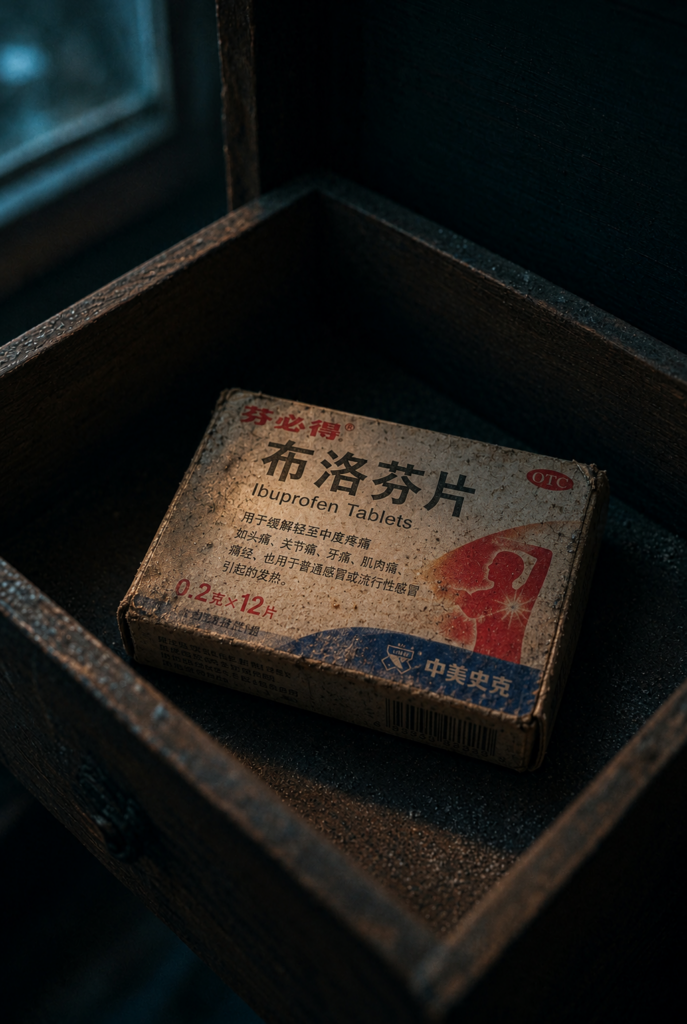
A small box of 12 Ibuprofen tablets languishes in a drawer. During the early days of the pandemic, even common over-the-counter medications such as this were in short supply.
This box of Ibuprofen that we went through so much trouble to get back then ended languishing in a drawer, and expired without ever being opened. We have no use for it nowadays, and at least there’s no need to spend good money listening to other people mouthing the lines “message received" on our behalf. [Chinese]

For further coverage, see CDT’s archive of translated propaganda directives, issued almost daily during the initial weeks and months of the COVID pandemic, which shed light on how the propaganda machinery attempted to grapple with the outbreak.