


A screenshot related to Nanjing University’s new classroom surveillance system has been circulating online, triggering intense debate among educational experts and the general public. Based on the screenshot and publicly available bid information for the 31-million-yuan “smart classroom system,” which Nanjing University reportedly installed on its Xianlin campus this summer, video cameras and an AI-powered analytical engine will assess teaching quality, student engagement, and classroom interactions in 113 classrooms and lecture halls. The system can reportedly detect faces, track posture and movements (such as whether students have their heads raised or lowered, and whether instructors are standing, seated, or walking around), and flag “sensitive words” in classroom discussions. These capabilities have raised alarm bells about privacy violations, surveillance culture, and potential constraints on academic discourse.
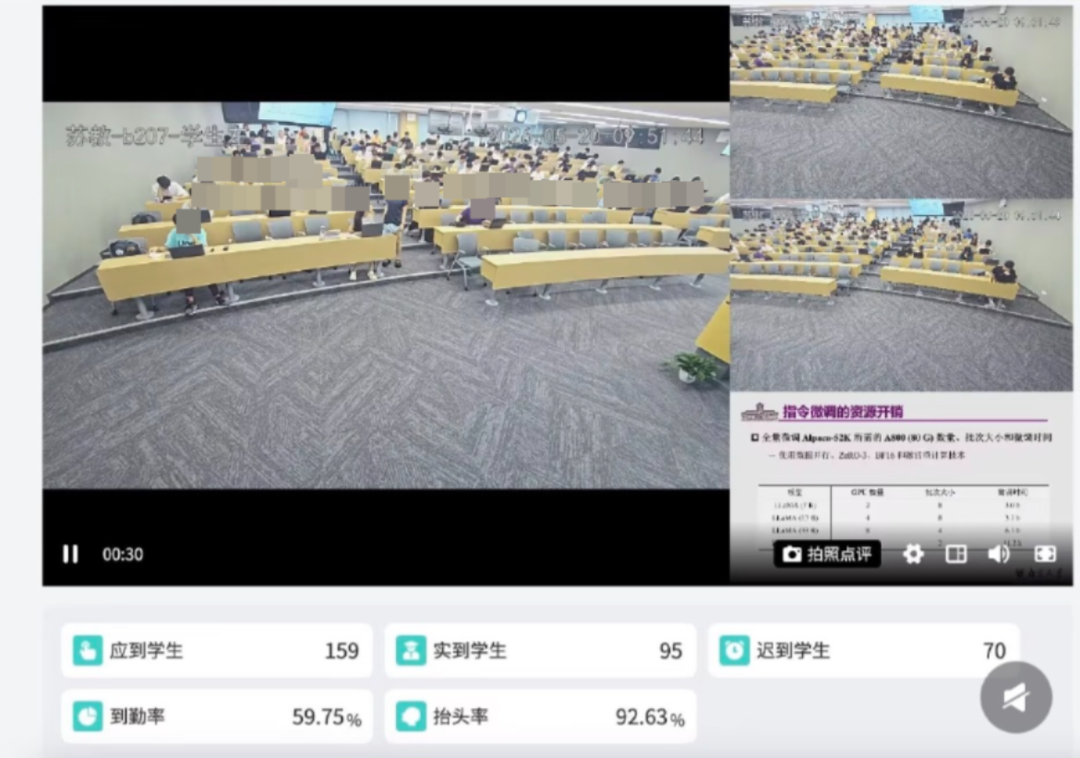
A viral screenshot shows static images from a Nanjing University lecture hall equipped with surveillance cameras. Below that are a number of stats (from left to right): Expected students: 159. Students present: 95. Students late: 70. Attendance rate: 59.75%. “Heads-up” rate: 92.63%.
CDT Chinese editors have archived three articles critical of Nanjing University’s new classroom surveillance system and the various dangers it poses. One, from WeChat account 锋言蜂语 (Fēngyán fēngyǔ, “Words that sting”), acknowledges that teaching quality and student attendance (not to mention attentiveness in class) could certainly be improved at many universities, but argues that there are better ways to achieve this than to place everyone under algorithmic surveillance without their consent. “While there may be valid reasons for this approach,” the author writes, “it should not be implemented in a coercive, unilateral manner. It requires communication, consultation, and the consent of faculty and students.”
Another archived article, from WeChat blogger Ye Kefei, raises some of the same concerns, and describes classroom surveillance systems as an outgrowth of excessive bureaucratism and gatekeeping at Chinese universities. Ye argues that in an already hypercompetitive academic environment, such systems will only increase pressure on students and may lead them to warp their behavior in the hope of gaming the algorithms:
Regardless of whether or not it leverages “smart” technology, tracking the “heads-up rate" reflects a managerial mindset better suited to test-prep mills or high-school disciplinary offices than to universities. Such measures have no place in higher education, for they threaten to systematically undermine the very nature of what a university is—a place for trust-based, non-coercive intellectual exchange between adults.
Using the "heads-up rate" as a proxy for attention paid in a university classroom is patently absurd. Looking up doesn’t mean you’re listening, and looking down doesn’t mean you’re not learning. One student might have her head bent, concentrating on reading a textbook, while another might have his head raised, but his mind is wandering. The algorithm can’t tell the difference between the two. Incorporating such a measure into student assessments would distort what is actually happening in the classroom, and could make students overly concerned with “performative” aspects such as physical posture. The algorithm threatens to erase perfectly normal academic behavior by penalizing things like expressing intellectual curiosity, feeling confused, or taking a moment to ponder an idea or glance down at a textbook.
The term "algorithmic gaze in education" is nothing new, and while many people think it’s merely an issue of privacy, the reality is far more complex. This “algorithmic gaze” isn’t an inevitable outgrowth of technological progress, but a distortion produced by grafting digital technology onto an exam-driven educational system. Rather than seeing students as flesh-and-blood human beings, the algorithmic gaze transforms them into a collection of "digital dossiers."
The more profound danger lies in how this reacts with our meritocratic system. Academic competition in universities today is already brutal, with a rigorous screening system defined by grade point averages, scholarships, and graduate school admission recommendations. Students are used to meticulously planning every phase of their academic careers under the pressure of these external evaluative methods. The "algorithmic gaze" expands this external scrutiny to another, physical, level. Now in addition to earning good grades, you have to look the part of a keen learner in every second of classroom surveillance footage. Under the weight of this sort of discipline, students will only grow more anxious, forced to contort themselves into whatever shape the algorithms (and the powers behind them) allow them to be.
[…] Technology is never neutral. When it is wielded by those with administrative power, embedded in the evaluation system, and targeted at students—those with the least bargaining power in the classroom—it becomes an “instrument of discipline.” As for the founding spirit of the university, that died off long ago. [Chinese]
The final archived article, “Nanjing University, How Could You Sink So Low?” is from prolific WeChat blogger Wei Chunliang, who attended Nanjing University for seven years, both as an undergraduate and as a graduate student. Wei identifies three major problems with the school’s new “smart classroom system”: privacy violations, excessive surveillance, and “sensitive word” recognition that threatens to quash academic debate and fuel self-censorship. Throughout, Wei uses the term “mingan词” for “sensitive word(s)” instead of the usual “敏感词” (mǐngǎncí), presumably to avoid censorship of his article, which remains visible on WeChat. An extensive excerpt is translated below:
I studied at Nanjing University (NJU) for seven years, and it’s fair to say that the best and happiest years of my life were those I spent on its campus.
NJU’s freedom and inclusivity gave me more than enough room to grow, and taught me about the joy of learning and the goodness of other people. I’ve always been proud of being an NJU alum and of the atmosphere that the school cultivated.
So I was terribly disappointed to read the news that the university would be implementing a “smart classroom system.” Nanjing University, I don’t understand—how could you sink so low?
[…] I downloaded the “Notice of Winning Bid for the Nanjing University Smart Classroom Instruction System,” which says the system supports AI-powered learning and teaching analytics with its built-in analytical engine capable of analyzing classroom video and generating updated reports every three minutes on the attendance rate, percentage of students seated in the front rows, percentage of students with their heads raised, and more. There is AI-powered analysis of classroom interactions, including the physical location and movements (walking around, sitting down, etc.) of the instructor. It also “supports stackable expansion of concurrent analysis capacity.”
Even more disturbingly, the system can identify “abnormal teaching behavior” (such as instructors using mobile phones, being late for class, or concluding class early), flag “sensitive words” used in the classroom, classify politically sensitive words into categories for “general scrutiny” and “special scrutiny,” and support the customization and import of sensitive-word lexicons.
The first issue here is one of privacy.
On Xiaohongshu [the social media platform RedNote], I read worried comments from NJU students and alumni: “I normally don’t even let apps access my location or full photo library,” wrote one. “But now, at one of China’s finest universities, cameras can record my face, attendance, classroom behavior, even whether I’m looking up or not, and feed them one by one into an AI for analysis.”
Another asked: “How can the school justify allowing an outside contractor default access to facial data from teachers and students? Facial data is sensitive personal information, and Article 29 of the Personal Information Protection Law explicitly requires separate consent for that. As far as I know, and from what I’ve heard from faculty and students, the school hasn’t notified them separately or obtained their consent. Do teachers and students have the right to refuse? Where’s the company storing the data, and for how long, and how will it be disposed of? Which department is in charge of overseeing this? If tens of thousands of people’s facial data is handed over to a third party and it leaks, who’ll be held responsible?"
NJU issued a clarification this morning, stating that "our smart classroom system does not collect facial or other biometric information or conduct facial recognition in educational applications without prior authorization." But given that the system is capable of recognizing faces, it’s only understandable that people might worry.
The system controls the “on/off switch” for that function. Saying it won’t be activated this time doesn’t mean that it won’t ever be activated, and teachers and students have no way of verifying whether it’s active or not. Teachers and students alike are required to attend class, so once this system is installed in classrooms, it means that in practical terms, none of them have the right to refuse to participate.
The real issue with privacy isn’t whether the system is currently collecting data, but the fact that teachers and students have no idea and no way of knowing when the system might be collecting data, and to what extent, and where that data will end up.
The second issue is classroom surveillance.
The system supports AI-powered learning and teaching analysis, and every three minutes, can output an updated analysis of the attendance rate, percentage of students sitting in the front rows, percentage of students with their heads raised, and the like. It also supports AI-powered teaching analysis of classroom interaction, including whether the teacher is standing, sitting, or walking around.
This design is based on a simple but outdated set of stereotypes—that those sitting in the front rows like obedient kindergartners must be diligent students, and that those looking up at the teacher or the blackboard must be paying close attention.
[…] If this rigid set of evaluation criteria is warped into some kind of standardized rubric, it could fuel performative approaches to learning and teaching. In order to “feed” the system and bolster their metrics, students may make a point of sitting in the front rows and keeping their heads raised, while teachers deliberately wander around the classroom and engage in superficial interactions.
But is this genuine education?
[…] The biggest problem with a system that surveils the classroom behavior of students and their instructors is that it doesn’t respect college students or see them as independent, autonomous adults.
[…] The third issue is the flagging of “sensitive words” used in classroom discussions.
[…] Universities are temples of learning and truth, the pursuit of which involves debate, inquiry, confronting errors head-on, and entertaining conclusions that may deviate from “the norm.”
But the major problem with this automatic sensitive-word recognition scheme stems from an inherent flaw in machine recognition: it struggles to comprehend the context in which words are used.
The same "sensitive" word or passage might be cited in an historical case study, a sociological discussion, a literature review, or a critical academic seminar, all of which are substantially different from actively promoting illegal content. Citing something is not tantamount to promoting or supporting it, and such citations are the norm in academic debate.
But machines can only match words against a lexicon, and they have difficulty telling various situations apart. With vague criteria for what constitutes a “sensitive word” and a lack of human oversight, relying solely on machine-generated alerts will exert a chilling effect on academia. To avoid accidentally triggering alerts, instructors might steer clear of anything controversial or thought-provoking. The effect would be to further constrict the space for normal discussion in university classrooms.
[…] Nanjing University’s statement insisted that "smart classrooms are now widespread at Chinese and overseas universities, and there is an inexorable trend toward using ‘smart’ technology to facilitate learning and teaching." But that is no excuse to allow technology to result in administrative overreach and dumbed-down teaching.
I was disheartened to see so many comments on Xiaohongshu from current NJU students saying things like, “I’ve barely noticed any difference yet, myself. I can’t understand why everyone’s so set against it.”
The apathy of such people saddens me. They don’t seem to realize that just because they’ve “barely noticed any difference yet” doesn’t mean that classroom surveillance is acceptable. Just because it hasn’t harmed them yet doesn’t prove that this sort of data gathering and evaluation system is legitimate.
The easiest time to implement technological discipline is when the majority of people feel like it’s “no big deal.”
Once a system capable of capturing video, analyzing physical posture, and matching keywords is fully implemented, it will encroach on everyone’s rights. Once a majority of people passively accept the system because they don’t think it affects them, the boundaries of our freedom will continue to shrink. [Chinese]
Nanjing University’s so-called “smart classroom system” is not an isolated case. According to reporting by The Paper, China Newsweek, and other news outlets, a number of institutions of higher learning—Jiangnan University, Heilongjiang University, Wenzhou University, Northeast Forestry University, Southern Medical University, Beijing Institute of Technology, Beihang University, Shenyang Institute of Technology, Ningxia Institute of Science and Technology, Qilu Institute of Technology, and others—have launched similar AI-powered teaching and classroom surveillance systems. Jiangnan University’s system generates “abnormal classroom” alerts based on risk levels, and Beihang’s system even factors the results of AI-powered classroom surveillance into instructors’ performance evaluations. When China Pharmaceutical University installed facial recognition in its classrooms back in 2019, an official from the Ministry of Education warned that such technology should be “used with caution.” Yet today, these systems have become standard at many universities.
Elsewhere, use of surveillance systems in other fields and applications continues to expand and intensify. Netizens have reported that some Xiaomi phones have preinstalled security components that upload large amounts of private user-data to Xiaomi servers, including SIM card identifiers and app usage records, making it easy for Chinese authorities to obtain data on users’ VPN use. In Beijing, police reportedly showed up at a resident’s door late at night asking to inspect a drone, simply because the resident had a history of purchasing and operating a drone in the past. (Rules in the capital tightened this month, and now prohibit even storing drones within the city.) Hong Kong police announced that this November, they will add AI facial recognition to the city’s “SmartView” CCTV system; they plan to install some 60,000 surveillance cameras across Hong Kong by 2028.