


The diplomatic crisis between China and Japan continues to intensify, following Japanese Prime Minister Sanae Takaichi’s affirmation last month of Japan’s willingness to defend Taiwan in the event of Chinese naval blockade of the island, a situation she described as a “survival-threatening situation” for Japan. Takaichi’s comments, made in response to a question from an opposition legislator in the Japanese Diet, were a marked departure from the Japanese government’s long-standing doctrine of “strategic ambiguity” regarding a potential conflict over Taiwan.
Her remarks drew furious responses from the Chinese Ministry of Foreign Affairs and Chinese consular officials in Japan, and prompted the Chinese government to issue an advisory against travel to Japan, halt Japanese seafood imports, cancel youth exchange programs and concerts by Japanese performers, and step up coast guard patrols around the disputed Senkaku Islands (known as the Diaoyu Islands in China). Although Takaichi has since backtracked somewhat, pointing out that she was only commenting on a hypothetical situation and reaffirming the Japanese government’s basic position regarding Taiwan as outlined in the 1972 Sino-Japanese joint statement, it has done little to quell Beijing’s ire. The hit to tourism alone could cost Japan as much as $1.2 billion in tourist spending by the end of the year; hotel bookings by Chinese travelers to Japan have reportedly dropped by more than 50%.
The spat between China and Japan has also dominated Chinese social media. CDT Chinese editors have archived at least 20 essays and articles (four are now censored) on various aspects of the conflict, as well as several compilations of online comments. Much of this content is focused on travel to Japan, an increasingly popular destination for Chinese tourists in recent years, and skepticism about Chinese government warnings that Japan is “unsafe” for Chinese travelers, and about blatant promotion of less safe alternative travel destinations such as Russia and Cambodia.
An article from WeChat account Mulan’s Worldview, “The Tourism Industry in China is a Chamberpot,” discusses the Chinese government’s history of weaponizing tourism during geopolitical disputes. Given that it is not considered a core strategic industry such as manufacturing or high-tech, writes the author, it has become a sector of convenience, vulnerable to various forms of manipulation and suppression:
If I were to sum up the position of China’s tourism industry within the national economic ecosystem, I’d say the term “chamber pot” is most fitting.
It is something to be picked up when needed, and cast aside when it is not. When it is needed to burnish political achievements, tourism is treated as a key driver of GDP growth, but at other times, it quickly becomes a disposable tool.
Over the past decade, I have witnessed the tourism industry being used, time and again, like an on-off switch in strategic situations such as pandemic control, economic recovery, and diplomatic spats. I believe that China’s tourism professionals have developed an unflappable, fearless attitude in the face of these catastrophes to which they have become so accustomed. [Chinese]
Notwithstanding government warnings and a drop in Japan-bound group travel, many in China remain unconvinced by government and state-media insistence that tourism to Japan is unwise, unsafe, or unpatriotic. One indication of this can be found in the comments section of a WeChat article from Breaking News (快速报, Kuàisùbào), titled, “Some People Just Won’t Listen! Despite China’s Travel Warning, There Are Still Long Queues at Pudong Airport for Flights to Japan.” The article reiterated warnings from China’s Ministry of Foreign Affairs against travel to Japan and listed various policies from Chinese airlines offering fee-free cancellation of flights to Japan, but also included a screenshot from the Asahi Shimbun showing long lines for Osaka-bound flights from Shanghai Pudong Airport. There were also Asahi Shimbun interviews with Chinese travelers, some of whom explained that they were "uninterested in politics" or that "political topics are irrelevant to me," while others appeared uncomfortable discussing their decision to travel to Japan. But most telling is the rowdy comments section, a portion of which is translated below:
宝: They’re yearning for civilization.
SUN: We’re not children; we all know whether Japan is safe or not.
默言: It seems there are still many clear-headed people who know that going to Japan is safer than going to Russia or North Korea.
望江月: Anyone who knows about traveling to Japan is probably not an idiot.
麦子: We’re not fooled that easily.
讴歌7685: I’m relieved to read these comments!
liping: But it’s safe to go to Russia!
帘卷西风: I just got back from Japan, and it’s perfectly safe.
松涧岩溪: Maybe it’s because Japanese tourist attractions don’t price-gouge tourists.
亮: The one who’s unpopular and really needs to be kicked out is that person.
慕尼黑尖脸: More and more people have seen the light.
风声雨声: A lot of my friends have traveled to Japan, and I haven’t heard of anyone who regretted it.
云卷云舒2: Who was it saying not long ago that Japanese seafood was safe to eat? But now I guess it’s contaminated with radiation again, right?
蕭爱華 Edward: These comments are way more interesting than the article itself, because they reflect public opinion.
管宇: You can choose not to go, but you can’t stop others from going, and you can’t impose your will on other people!
鱼儿里的猫: Why isn’t there a warning against traveling to Russia? They’re in a state of war over there. [Chinese]
There was further online pushback in response to a spate of state-media articles touting Russia and Cambodia as desirable alternative travel destinations. A piece from CCTV.com claimed “Flight Volume Surges! Russia Replaces Japan as New Favorite for Chinese Tourists,” while the Beijing Youth Daily lauded Cambodia’s new visa-free policy for Chinese travelers. At WeChat account History Rhymes, blogger and current affairs commentator Xu Peng (whose other WeChat account, Du Fu of Huanhua Creek, was recently deleted after he published an article questioning online comments about Sino-Japanese tensions) praised the “hilarious comment section” under the CCTV.com piece. This is illustrated with screenshots showing a long string of comments all parroting the same phrase: “Think for yourself, and decide what’s right and what’s wrong” (独立思考,明辨是非, Dúlì sīkǎo, míngbiàn shì-fēi). Xu points out that this same motto appears on the official Weibo account for Tesla Motors’ legal department: it proved so popular that the Tesla account soon drew over 100,000 followers, despite having only one “like” and having posted no content. Naturally, Xu urges his readers to “think for yourself, and decide what’s right and what’s wrong” when deciding whether to take a holiday jaunt to Russia or Cambodia.
CDT Chinese editors have compiled some of the comments from Zhihu users in response to the question: “What’s your opinion of CCTV.com’s claim that Russia has replaced Japan as the new favorite destination for Chinese tourists?” A selection of these are translated below:
李若: Recommending a country that is at war and encouraging your citizens to travel there—is that responsible behavior?
momo: One minute the authorities are promoting Cambodia, the next they’re promoting Russia: they must really love us.
nowonder: I can’t get my head around why people would be clamoring to go to a country that is unfriendly to China (to Chinese people, that is) and is currently in a state of war.
东门吹雪: Whenever they’re really talking up something, you can’t believe a word they say.
小朋友的问号: You can’t even buy travel insurance for Russia. Think about that.
吕旻园: For tourism, go to Russia; for work, go to Myanmar; for business, go to North Korea; for study abroad, go to Iran. These are the best options for today’s generation of young Chinese.
WitnessPass: Seriously, I don’t get it. First it’s Cambodia, then it’s Russia … why can’t they recommend a decent travel destination? What’ll they push next, North Korea or Iran?
wuyuesanren: This is the first time I’ve seen a government actively encourage its citizens to travel to another country at war. It’s also the first time I’ve seen a government knowingly promote tourism to another country that treats its citizens like swine. This isn’t some grand patriotic gesture: it’s like sending pigs to the slaughter. [Chinese]
There were also many humorous and satirical pieces on the China-Japan tourism flap, including this one from WeChat blogger Just Call Me Xiong Taihang, who pushed back against a livestream viewer who seemed intent on goading Xiong Taihang to comment on Sanae Takaichi’s stance on Taiwan. Instead, Xiong Taihang wrote a satirical article “So You’re Not Allowed to Go to Japan? Well, Japan’s Loss is Hebei’s Gain!” comparing the natural scenery, cuisine, and historical sites of his native Hebei province favorably with Japan, and sardonically urging readers to consider spending their tourist dollars in Hebei instead:

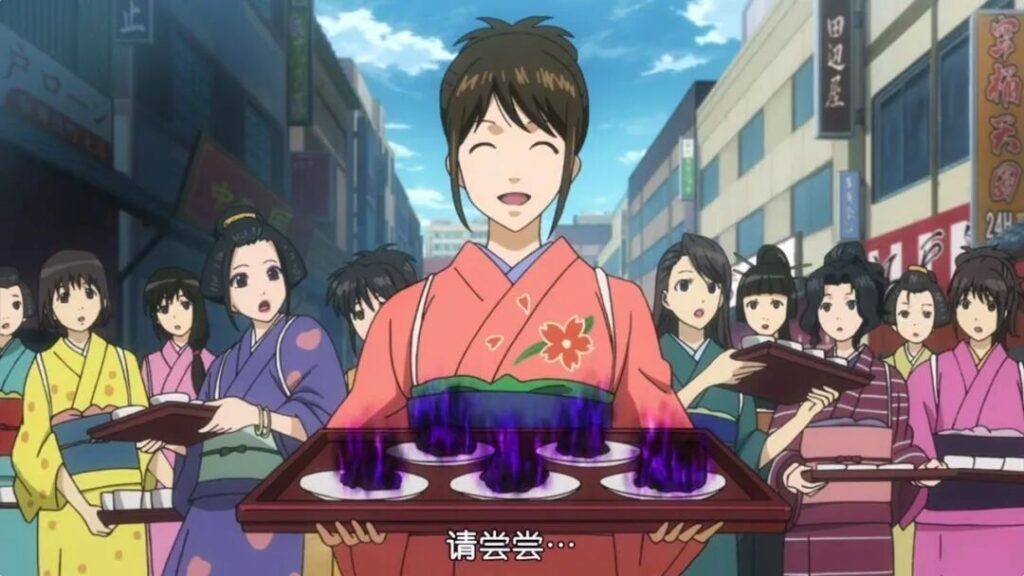
Please give this a taste! (source: still image from the anime Gintama, republished by WeChat Account 就叫熊太行也行 “Just Call Me Xiong Taihang”)
Listen, I’m the most patriotic person around. And you know how I show it?
Patriotism means loving your hometown, and my hometown is Shijiazhuang [the capital of Hebei province].
Given current Sino-Japanese tensions, the Ministry of Foreign Affairs is telling folks that visiting Japan is a no-go.
So hurry on over to Hebei, this former hotbed of WWII anti-Japanese resistance.
And I’ll let you in on a little secret: whatever Japan has, Hebei has it, too.
Not that Japan’s out of your price range, but Hebei offers better value for money.
Japan has Mount Fuji. Hebei has Mount Ma Liu!
Japan has Okinawa. Hebei has Nandaihe Beach Resort!
Japan has Lake Biwa. Hebei has Baiyangdian Lake! (And the locals have stopped slashing car tires!)
Japan has Hokkaido. Hebei has Zhangjiakou!
Japan has Mount Koya. Hebei has Little Mount Wutai!
Japan has Nara’s famous deer. Hebei has Taihang’s miniature donkeys!
Japan has the ancient imperial capital of Kyoto. Hebei has Xiong’an New Area!
Japan has nigiri sushi. Hebei has scallion-pancake stir fry!
Japan has curry rice. Hebei has stir-fried mung-bean jelly!
Japan has sumo wrestling. Hebei has Baoding wrestling!
[…] Japan has ramen. Hebei has authentic Anhui beef noodles!
Japan has Tokyo’s Ginza District. Hebei has Shijiazhuang’s Nansantiao Wholesale Market!
[…] Hebei: so close, so lovely. Give Japan a miss, and visit us instead.
The Hebei renaissance is close at hand! [Chinese]